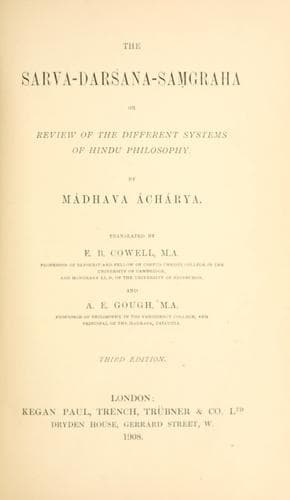
The Sarva-Darsana-Samgraha: Or, Review of the Different Systems of Hindu Philosophy — John Shaqi
The Sarva-Darsana-Samgraha: Or, Review of the Different Systems of Hindu PhilosophyMadhava
ReligionEastern
The Sarva-Darsana-Samgraha: Or, Review of the Different Systems of Hindu Philosophy
Madhava
Philosophy, Hindu; Philosophy, Indic
Nor must it be supposed that (on this hypothesis) the juice, the
energy, and the digestion derivable from an imaginary and an actual
sweetmeat will be the same; for it cannot be questioned that though
the intellect be in strictness exempt from the modes of object and
subject, yet there is competent to it a practical distinction in
virtue of the succession of illusory ideas without beginning, by
reason of its possessing diverse modes percept and percipient,
conformably to its illusory supposition of practical agency, just as
to those whose eyes are dim with some morbid affection a hair and
another minute object may appear either diverse or identical; as it
has been said--
"As the intellect, not having object and subject modes,
appears, by reason of illusory cognitions,
"Illuded with the diverse forms of perception, percept and
percipient;
"So when the intellect has posited a diversity, as in the
example of the differences of the cognition of a hair and
the like,
"Then it is not to be doubted that it is characterised as
percipient and percept."
Thus it has been evinced that intellect, as affected by beginningless
ideation, manifests itself under diverse forms.
When, therefore, by constancy of reflection (on the four points of
view) aforesaid, all ideation has been interrupted, there arises
knowledge purged from the illusions which take the form of objects,
such illusions being now melted away; and this is technically called
_Mahodaya_ (the grand exaltation, emancipation).
Others again (the Sautrántikas) hold that the position that there is
no external world is untenable, as wanting evidence. Nor (they
contend) can it be maintained that invariability of simultaneous
cognition is an evidence, for this simultaneous cognition which you
accept as proof of the identity of subject and object is indecisive,
being found in dubious and in contrary instances. If you rejoin (they
proceed): Let there be a proof of this identity, and let this proof be
invariability of simultaneous cognition,--we refuse this, because
inasmuch as cognition must ultimately have some object, it is
manifested in duality, and because such invariability of simultaneity
as to time and place is impossible. Moreover (they continue), if the
object, blue or whatever it be, were only a form of cognition, it
should be presented as _Ego_, not as _Hoc aliquid_, because the
cognition and the object would be identical. Perhaps you will say: A
blue form consisting of cognition is illusorily presented as external
and as other than self, and consequently the Ego is not suggested; and
so it has been said--
"This side of knowledge which appears external to the other
portion,
"This appearance of duality in the unity of cognition is an
illusion."
And again--
"The principle to be known as internal also manifests itself
as if it were external."
Public-domain text, read in full here on John Shaqi.
Reviews
Reviews
No reviews yet
Be the first to share your thoughts on this work.
Join the Discussion
Join the discussion
Sign in to leave a comment or review.
Sign InorCreate an account