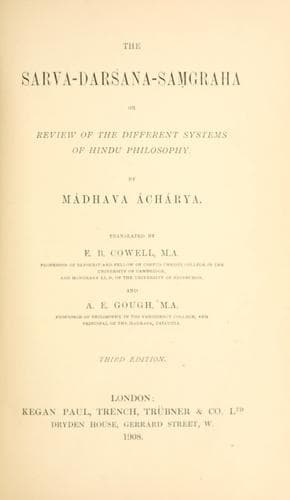
The Sarva-Darsana-Samgraha: Or, Review of the Different Systems of Hindu PhilosophyMadhava
ReligionEastern
The Sarva-Darsana-Samgraha: Or, Review of the Different Systems of Hindu Philosophy
Madhava
Philosophy, Hindu; Philosophy, Indic
To this we reply (say the Sautrántikas): This is untenable, for if
there be no external objects, there being no genesis of such, the
comparison "as if they were external" is illegitimate. No man in his
senses would say, "Vasumitra looks like the son of a childless
mother." Again, if the manifestation of identity be proved by the
illusoriness of the presentment of duality, and the presentment of
duality be proved illusory by the manifestation of identity, you are
involved in a logical circle. Without controversy we observe that
cognitions take external things, blue or whatever they may be, as
their objects, and do not take merely internal modifications as such,
and we see that men in their everyday life overlook their internal
states. Thus this argument which you adduce to prove that there is
difference between subject and object, turns out a mere absurdity,
like milky food made of cow-dung. When then you say "as if it were
external," you must already suppose an external _percipibile_, and
your own arrow will return upon you and wound you.
If any one object that the externality of an object synchronous with
the cognition is inadmissible, we (Sautrántikas) reply that this
objection is inadmissible, inasmuch as the subject in juxtaposition to
the sensory imposes its form upon the cognition then in production,
and the object is inferrible from the form thus imposed. The
interrogation and response on this point have been thus summarised--
"If it be asked, How can there be a past _percipibile_? They
recognise perceptibility,
"And a competent inferribility of the individual thing is
its imposition of its form."
To exemplify. As nourishment is inferred from a thriving look, as
nationality is inferred from language, and as affection is inferred
from flurried movements, so from the form of knowledge a knowable may
be inferred. Therefore it has been said--
"With half (of itself) the object moulds (the cognition)
without losing the nature of a half;
"The evidence, therefore, of the recognition of a knowable
is the nature of the knowable."
For consciousness of the cognition cannot be the being of the
cognition, for this consciousness is everywhere alike, and if
indifference were to attach itself to this, it would reduce all things
to indifference. Accordingly the formal argument for the existence of
external things: Those things which while a thing exists appear only
at times, all depend upon something else than that thing; as, for
instance, if I do not wish to speak or to walk, presentments of
speaking or walking must suppose others desirous of speaking or
walking; and in like manner the presentments of activity under
discussion, while there exists the recognition of a subject of them,
are only at times manifested as blue and so forth. Of these, the
recognition of a subject is the presentation of the Ego, the
manifestation as blue and so forth is a presentment of activity, as
it has been said--
Public-domain text, read in full here on John Shaqi.
Reviews
Reviews
No reviews yet
Be the first to share your thoughts on this work.
Join the Discussion
Join the discussion
Sign in to leave a comment or review.
Sign InorCreate an account