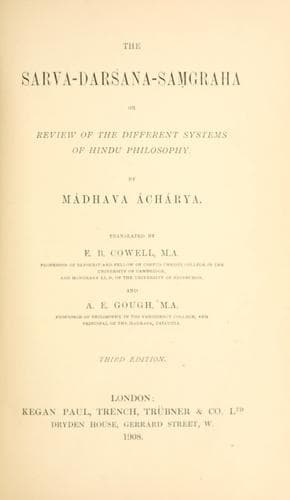
The Sarva-Darsana-Samgraha: Or, Review of the Different Systems of Hindu PhilosophyMadhava
ReligionEastern
The Sarva-Darsana-Samgraha: Or, Review of the Different Systems of Hindu Philosophy
Madhava
Philosophy, Hindu; Philosophy, Indic
"That is a recognition of a subject which is conversant
about the Ego:
"That is a presentment of activity which manifests blue and
the rest."
Over and above, therefore, the complement of subject-recognitions, let
it be understood that there is an external object world perceptible,
which is the cause of presentments of activity; and that this external
world does not rise into being only from time to time on occasion of
presentments resulting from ideation.
According to the view of the Sensationalists (_vijñánavádin_),
ideation is a power of generating such and such sensations (or
presentments of activity) in subject-recognitions which exist as a
single stream. The maturescence of this power is its readiness to
produce its effect; of this the result is a presentment (or
sensation); the antecedent momentary object (sensation) in the mental
train is accepted as the cause, no other mental train being admitted
to exercise such causality. It must therefore be stated that all
momentary objects (fleeting sensations) in the subject-consciousness
are alike able to bring about that maturescence of ideation in the
subject-consciousness, which maturescence is productive of
presentments of activity. If any one (of these fleeting sensations)
had not this power, none would possess it, all existing alike in the
stream of subject-recognitions. On the supposition that they all have
this power, the effects cannot be diversified, and therefore any
intelligent man, however unwilling, if he has a clear understanding,
must decide, without putting out of sight the testimony of his
consciousness, that to account for the occasional nature (of sense
percepts) the six cognitions of sound, touch, colour, taste, and
smell, of pleasure, and so forth, are produced on occasion of four
conditions. These four conditions are known as (1.) the data, (2.) the
suggestion, (3.) the medium, and (4.) the dominant (organ). Of these,
the form of blue or the like arises from the condition of blue data in
the understanding in which there is a manifestation of blue or the
like, which manifestation is styled a cognition. The resuscitation of
forms or cognitions arises from suggestion as a condition. The
restriction to the apprehension of this or that object arises from the
medium, light, for instance, as a condition, and from the dominant,
the eye, for example, as another condition. The eye, as determinant of
one particular cognition (form) where taste, &c., might have been
equally cognised, is able to become dominant; for in everyday life he
who determines is regarded as dominant. We must thus recognise four
causes of pleasure and the rest which constitute the understanding and
its modifications.
Public-domain text, read in full here on John Shaqi.
Reviews
Reviews
No reviews yet
Be the first to share your thoughts on this work.
Join the Discussion
Join the discussion
Sign in to leave a comment or review.
Sign InorCreate an account