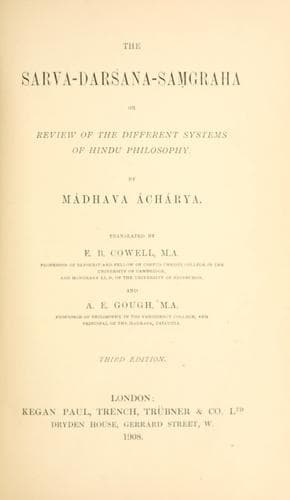
The Sarva-Darsana-Samgraha: Or, Review of the Different Systems of Hindu PhilosophyMadhava
ReligionEastern
The Sarva-Darsana-Samgraha: Or, Review of the Different Systems of Hindu Philosophy
Madhava
Philosophy, Hindu; Philosophy, Indic
So also the universe, which consists of mind and its modifications, is
of five kinds, entitled (1.) the sensational, (2.) the perceptional,
(3.) the affectional, (4.) the verbal, and (5.) the impressional. Of
these, the sensible world (_rúpa-skandha_) is the sense organs and
their objects, according to the etymology, viz., that objects are
discriminated (_rúpyante_) by these. The perceptional world is the
stream of subject-recognitions and of presentments of activity. The
affectional world is the stream of feelings of pleasure and pain
generated by the two aforesaid worlds. The verbal (or symbolical)
world is the stream of cognitions conversant about words--the words
"cow," and so forth. The impressional world is the miseries, as
desire, aversion, &c., caused by the affectional world, the lesser
miseries, as conceit, pride, &c., and merit and demerit.
Reflecting, therefore, that this universe is pain, an abode of pain,
and an instrument of pain, a man should acquire a knowledge of the
principles, the method of suppressing this pain. Hence it has been
said--
"The principles sanctioned by Buddha are to the saint the
four methods of suppressing the aggregate of pain."[36]
In these words the sense of pain is known to every one; the
"aggregate" means the cause of pain. This aggregate is twofold, as
(1.) determined by concurrence; or (2.) determined by causation. Of
these, there is an aphorism comprising the aggregate determined by
concurrence, "which other causes resort to this effect;" the condition
of these causes thus proceeding is concurrence; the concurrence of
causes is the result of this only, and not of any conscious
being,--such is the meaning of the aphorism. To exemplify this. A
germ, caused by a seed, is generated by the concurrence of six
elements. Of these, earth as an element produces hardness and smell in
the germ; water as an element produces viscidity and moisture; light
as an element produces colour and warmth; air as an element produces
touch and motion; ether as an element produces expansion and sound;
the season as an element produces a fitting soil, &c. The aphorism
comprising the aggregate determined by causation is: "With the
Tathágatas the nature of these conditions is fixed by production, or
by non-production; there is continuance as a condition, and
determination by a condition, and conformity of the production to the
cause;" that is to say, according to the doctrine of the Tathágata
Buddhas, the nature of these conditions, that is, the causal relation
between the cause and effect, results from production or from
non-production. That which comes into being, provided that something
exists, is the effect of that as its cause; such is the explanation of
the nature (or causal relation). Continuance as a condition is where
the effect is not found without its cause. The (abstract) affix _tal_
(in the word _sthititā_) has the sense of the concrete. Determination
Public-domain text, read in full here on John Shaqi.
Reviews
Reviews
No reviews yet
Be the first to share your thoughts on this work.
Join the Discussion
Join the discussion
Sign in to leave a comment or review.
Sign InorCreate an account