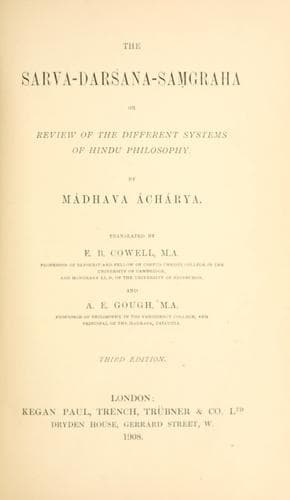
The Sarva-Darsana-Samgraha: Or, Review of the Different Systems of Hindu PhilosophyMadhava
ReligionEastern
The Sarva-Darsana-Samgraha: Or, Review of the Different Systems of Hindu Philosophy
Madhava
Philosophy, Hindu; Philosophy, Indic
by a condition is the determination of the effect by the cause. Here
some one might interpose the remark that the relation of cause and
effect cannot exist apart from some conscious agent. For this reason
it is added that there existing a cause, conformity of the genesis to
that cause is the nature which is fixed in conditions (that is, in
causes and effects); and in all this no intelligent designer is
observed.[37] To illustrate this, the causal determination of a
genesis to be gone through is as follows:--From the seed the germ,
from the germ the stalk, from the stalk the hollow stem, from the
hollow stem the bud, from the bud the spicules, from the spicules the
blossom, from the blossom the fruit. In this external aggregate
neither the cause, the seed and the rest, nor the effect, the germ and
the rest, has any consciousness of bringing a germ into being, or of
being brought into being by the seed. In like manner in mental facts
two causes are to be recognised. There is a whole ocean of scientific
matter before us, but we desist, apprehensive of making our treatise
unduly prolix.
Emancipation is the suppression of these two causal aggregates, or the
rise of pure cognition subsequent to such suppression. The method
(path, road) is the mode of suppressing them. And this method is the
knowledge of the principles, and this knowledge accrues from former
ideas. Such is the highest mystery. The name Sautrántika arose from
the fact that the venerated Buddha said to certain of his disciples
who asked what was the ultimate purport (_anta_) of the aphorism
(_sútra_), "As you have inquired the final purport of the aphorism, be
Sautrántikas."
Certain Bauddhas, though there exist the external world, consisting of
odours, &c., and the internal, consisting of colours, &c., in order to
produce unbelief in these, declared the universe to be a void. These the
venerated Buddha styled Práthamika (primary) disciples. A second school,
attached to the apprehension of sensations only, maintain that sensation
is the only reality. A third school, who contend that both are true (the
internal and the external), and maintain that sensible objects are
inferrible. Others hold all this to be absurd language (_viruddhá
bháshá_), and are known under the designation of Vaibháshikas. Their
technical language springs up as follows:--According to the doctrine of
inferrible sensibles, there being no perceptible object, and consequently
no object from which a universal rule can be attained, it will be
impossible that any illation should take place, and therefore a
contradiction will emerge to the consciousness of all mankind. Objects,
therefore, are of two kinds, sensible and cogitable. Of these apprehension
is a non-discriminative instrument of knowledge as other than mere
representation; cognition which is discriminative is not a form of
evidence, as being a merely ideal cognition. Therefore it has been said--
Public-domain text, read in full here on John Shaqi.
Reviews
Reviews
No reviews yet
Be the first to share your thoughts on this work.
Join the Discussion
Join the discussion
Sign in to leave a comment or review.
Sign InorCreate an account