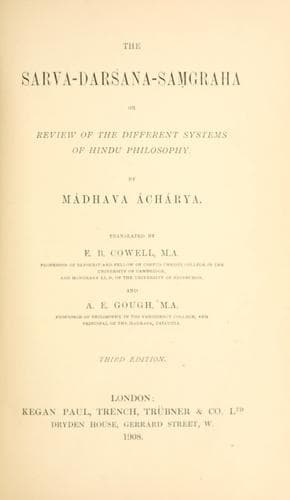
The Sarva-Darsana-Samgraha: Or, Review of the Different Systems of Hindu Philosophy — John Shaqi
The Sarva-Darsana-Samgraha: Or, Review of the Different Systems of Hindu PhilosophyMadhava
ReligionEastern
The Sarva-Darsana-Samgraha: Or, Review of the Different Systems of Hindu Philosophy
Madhava
Philosophy, Hindu; Philosophy, Indic
"Apprehension, exempt from ideality and not illusory, is
non-discriminative. Discrimination, as resulting from the
appearances of things, is without controversy an illusion.
"The perceptible evidence of things is perception: if it
were aught else,
"There could neither be things, nor evidence of things
derived from verbal communication, inference, or sense."
Here some one may say: If discriminative cognition be unauthentic, how
is the apprehension of real objects by one energising thereon and the
universal consentiency of mankind to be accounted for? Let it be
replied: This question does not concern us, for these may be accounted
for by the possibility of an indirect apprehension of objects, just as
if we suppose the light of a gem to be a gem (we may yet handle the
gem, because it underlies the light, while if we were to take nacre
for silver, we could not lay hold of any silver). The rest has been
fully discussed in describing the Sautrántikas (cf. p. 27), and
therefore need not here be further detailed.
It should not be contended that a diversity of instruction according
to the disciples' modes of thought is not traditional (or orthodox);
for it is said in the gloss on the Bodha-chitta--
"The instructions of the leader of mankind (Buddha)
accommodating themselves to the character and disposition
(of those who are to be taught),
"Are said to be diverse in many ways, according to a
plurality of methods.
"For as deep or superficial, and sometimes both deep and
superficial,
"Instructions are diverse, and diverse is the doctrine of a
universal void which is a negation of duality."
It is well known in Buddhist doctrine that the worship of the twelve
inner seats (_áyatana_) is conducive to felicity.
"After acquiring wealth in abundance, the twelve inner seats
"Are to be thoroughly reverenced; what use of reverencing
aught else below?
"The five organs of knowledge, the five organs of action,
"The common sensory and the intellect have been described by
the wise as the twelve inner seats."
The system of the Buddhists is described as follows in the
Viveka-vilása:--
"Of the Bauddhas Sugata (Buddha) is the deity, and the
universe is momentarily fluxional;
"The following four principles in order are to be known by
the name of the noble truths:--
"Pain, the inner seats, and from them an aggregate is
held,[38]
"And the path (method); of all this let the explication be
heard in order.
"Pain, and the _skandhas_ of the embodied one, which are
declared to be five,--
"Sensation, consciousness, name, impression, and form.
"The five organs of sense, the five objects of sense, sound
and the rest, the common sensory,
"And (the intellect) the abode of merit,--these are the
twelve inner seats.
Public-domain text, read in full here on John Shaqi.
Reviews
Reviews
No reviews yet
Be the first to share your thoughts on this work.
Join the Discussion
Join the discussion
Sign in to leave a comment or review.
Sign InorCreate an account