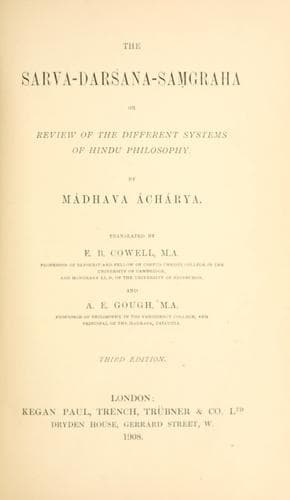
The Sarva-Darsana-Samgraha: Or, Review of the Different Systems of Hindu PhilosophyMadhava
ReligionEastern
The Sarva-Darsana-Samgraha: Or, Review of the Different Systems of Hindu Philosophy
Madhava
Philosophy, Hindu; Philosophy, Indic
"This should be the complement of desire and so forth, when
it arises in the heart of man.
"Under the name of soul's own nature, it should be the
aggregate.
"The fixed idea that all impressions are momentary,
"This is to be known as the path, and is also styled
emancipation.
"Furthermore, there are two instruments of science,
perception and inference.
"The Bauddhas are well known to be divided into four sects,
the Vaibháshikas and the rest.
"The Vaibháshika highly esteems an object concomitant to the
cognition;
"The Sautrántika allows no external object apprehensible by
perception;
"The Yogáchára admits only intellect accompanied with forms;
"The Mádhyamikas hold mere consciousness self-subsistent.
"All the four (sects of) Bauddhas proclaim the same
emancipation,
"Arising from the extirpation of desire, &c., the stream of
cognitions and impressions.
"The skin garment, the water-pot, the tonsure, the rags, the
single meal in the forenoon,
"The congregation, and the red vesture, are adopted by the
Bauddha mendicants."[39]
A. E. G.
FOOTNOTES:
[Footnote 29: This śloka is quoted in the "Benares Pandit," vol. i. p.
89, with a commentary, and the latter part of the second line is there
read more correctly, _'darśanán na na darśanát_.]
[Footnote 30: Kusumánjali, iii. 7.]
[Footnote 31: The Bauddhas are thus divided into--
(1.) Mádhyamikas or Nihilists.
(2.) Yogácháras or Subjective Idealists.
(3.) Sautrántikas or Representationists.
(4.) Vaibháshikas or Presentationists.]
[Footnote 32: Cf. Ferrier's Lectures and Remains, vol. i. p. 119.
"Suppose yourself gazing on a gorgeous sunset. The whole western
heavens are glowing with roseate hues, but you are aware that within
half an hour all these glorious tints will have faded away into a dull
ashen grey. You see them even now melting away before your eyes,
although your eyes cannot place before you the conclusion which your
reason draws. And what conclusion is that? That conclusion is that you
never, even for the shortest time that can be named or conceived, see
any abiding colour, any colour which truly _is_. Within the millionth
part of a second the whole glory of the painted heavens has undergone
an incalculable series of mutations. One shade is supplanted by
another with a rapidity which sets all measurement at defiance, but
because the process is one to which no measurement applies,... reason
refuses to lay an arrestment on any period of the passing scene, or to
declare that it is, because in the very act of being it is not; it has
given place to something else. It is a series of fleeting colours, no
one of which _is_, because each of them continually vanishes in
another."]
[Footnote 33: Principium exclusi medii inter duo contradictoria.]
[Footnote 34: Query, Laṅkávatára?]
Public-domain text, read in full here on John Shaqi.
Reviews
Reviews
No reviews yet
Be the first to share your thoughts on this work.
Join the Discussion
Join the discussion
Sign in to leave a comment or review.
Sign InorCreate an account