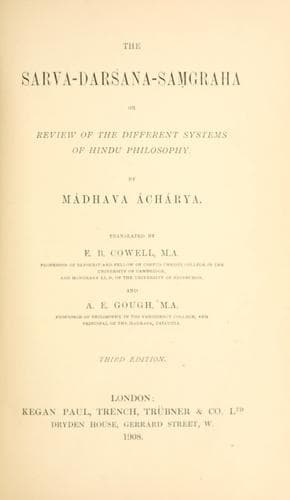
The Sarva-Darsana-Samgraha: Or, Review of the Different Systems of Hindu PhilosophyMadhava
ReligionEastern
The Sarva-Darsana-Samgraha: Or, Review of the Different Systems of Hindu Philosophy
Madhava
Philosophy, Hindu; Philosophy, Indic
[Footnote 35: Cf. Ferrier's Institutes of Metaphysic, p. 213. "If
every _completed_ object of cognition must consist of object _plus_
the subject, the object without the subject must be incomplete, that
is, inchoate--that is, no possible object of knowledge at all. This is
the distressing predicament to which matter is reduced by the tactics
of speculation; and this predicament is described not unaptly by
calling it a _flux_--or, as we have depicted it elsewhere, perhaps
more philosophically, as a never-ending redemption of nonsense into
sense, and a never-ending relapse of sense into nonsense."]
[Footnote 36: Cf. Burnouf, _Lotus_, p. 520.--Should we read
_samudaya_?]
[Footnote 37: Cf. G. H. Lewes' History of Philosophy, vol. i. p. 85.
"We not only see that the architect's plan determined the arrangement
of materials in the house, but we see why it must have done so,
because the materials have no spontaneous tendency to group themselves
into houses; that not being a recognised property of bricks, mortar,
wood, and glass. But what we know of organic materials is that they
_have_ this spontaneous tendency to arrange themselves in definite
forms; precisely as we see chemical substances arranging themselves in
definite forms without the intervention of any extra-chemical
agency."]
[Footnote 38: These are not the usual four 'sublime truths;' cf. p.
30.]
[Footnote 39: Mádhava probably derived most of his knowledge of
Buddhist doctrines from Brahmanical works; consequently some of his
explanations (as, _e.g._, that of _samudáya_ or _samudaya_, &c.) seem
to be at variance with those given in Buddhist works.]
CHAPTER III.
THE ÁRHATA SYSTEM.
The Gymnosophists[40] (Jainas), rejecting these opinions of the
Muktakachchhas,[41] and maintaining continued existence to a certain
extent, overthrow the doctrine of the momentariness of everything.
(They say): If no continuing soul is accepted, then even the
arrangement of the means for attaining worldly fruit in this life will
be useless. But surely this can never be imagined as possible--that
one should act and another reap the consequences! Therefore as this
conviction, "I who previously did the deed, am the person who now reap
its consequences," establishes undoubtedly the existence of a
continuing soul, which remains constant through the previous and the
subsequent period, the discriminating Jaina Arhats reject as untenable
the doctrine of momentary existence, _i.e._, an existence which lasts
only an instant, and has no previous or subsequent part.
Public-domain text, read in full here on John Shaqi.
Reviews
Reviews
No reviews yet
Be the first to share your thoughts on this work.
Join the Discussion
Join the discussion
Sign in to leave a comment or review.
Sign InorCreate an account