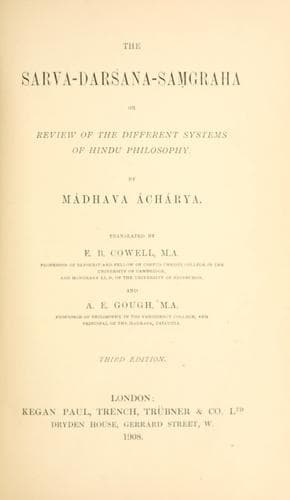
The Sarva-Darsana-Samgraha: Or, Review of the Different Systems of Hindu PhilosophyMadhava
ReligionEastern
The Sarva-Darsana-Samgraha: Or, Review of the Different Systems of Hindu Philosophy
Madhava
Philosophy, Hindu; Philosophy, Indic
But the opponent may maintain, "The unbroken stream (of momentary
sensations) has been fairly proved by argument, so who can prevent it?
In this way, since our tenet has been demonstrated by the argument,
'whatever is, is momentary, &c.,' it follows that in each parallel
line of successive experiences the previous consciousness is the agent
and the subsequent one reaps the fruit. Nor may you object that, 'if
this were true, effects might extend beyond all bounds'--[_i.e._, A
might act, and B receive the punishment]--because there is an
essentially controlling relation in the very nature of cause and
effect. Thus we see that when mango seeds, after being steeped in
sweet juices, are planted in prepared soil, there is a definite
certainty that sweetness will be found in the shoot, the stalk, the
stem, the branches, the peduncle, &c., and so on by an unbroken series
to the fruit itself; or again, when cotton seeds have been sprinkled
with lac juice, there will be a similar certainty of finding, through
the same series of shoot, &c., an ultimate redness in the cotton. As
it has been said--
"'In whatever series of successive states the original
impression of the action was produced,
"'There verily accrues the result, just like the redness
produced in cotton.
"'When lac juice, &c., are poured on the flower of the
citron, &c.,
"'A certain capacity is produced in it,--do you not see
it?'"
But all this is only a drowning man's catching at a straw, for it is
overthrown by the following dilemma:--
In the example of the "cloud," &c. [_supra_, p. 15], was your
favourite "momentariness" proved by this very proof or by some other?
It could not be the former, because your alleged momentariness is not
always directly visible in the cloud, and consequently, as your
example is not an ascertained fact, your supposed inference falls to
the ground. Nor can it be the latter--because you might always prove
your doctrine of momentariness by this new proof (if you had it), and
consequently your argument regarding all existence ["whatever is, is
momentary," &c.] would become needless. If you take as your definition
of "existence" "that which produces an effect," this will not hold, as
it would include even the bite of a snake imagined in the rope, since
this undoubtedly produces the effect [of fear]. Hence it has been
said that the definition of an existence is "that which possesses an
origin, an end, and an [intermediate] duration."
Public-domain text, read in full here on John Shaqi.
Reviews
Reviews
No reviews yet
Be the first to share your thoughts on this work.
Join the Discussion
Join the discussion
Sign in to leave a comment or review.
Sign InorCreate an account