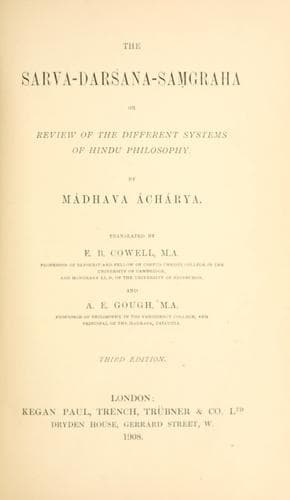
The Sarva-Darsana-Samgraha: Or, Review of the Different Systems of Hindu PhilosophyMadhava
ReligionEastern
The Sarva-Darsana-Samgraha: Or, Review of the Different Systems of Hindu Philosophy
Madhava
Philosophy, Hindu; Philosophy, Indic
As for what was said [in p. 16] that "the momentariness of objects is
proved by the fact that the contrary assumption leads to contradictory
attributes of capacity and want of capacity existing contemporaneously,"
_that_ also is wrong--for the alleged contradiction is not proved, as the
holders of the Syád-váda[42] doctrine [_vide infra_] willingly admit the
indeterminateness of the action of causes. As for what was said of the
example of the cotton, that is only mere words, since no proof is given,
and we do not accept even in that instance a separate destruction [at each
moment]. And again, your supposed continued series cannot be demonstrated
without some subject to give it coherence, as has been said, "In
individual things which are of the same class or successively produced or
in mutual contact, there may be a continued series; and this series is
held to be one [throughout all"].
Nor is our objection obviated by your supposed definite relation
between causes and effects. For even on your own admission it would
follow that something experienced by the teacher's mind might be
remembered by that of the pupil whom he had formed, or the latter
might experience the fruits of merit which the former had acquired;
and thus we should have the twofold fault that the thing done passed
away without result, and that the fruit of the thing not done was
enjoyed. This has been said by the author of the Siddhasenávákya--
"The loss of the thing done,--the enjoyment of the fruit of a thing
not done,--the dissolution of all existence,--and the abolition of
memory,--bold indeed is the Buddhist antagonist, when, in the teeth of
these four objections, he seeks to establish his doctrine of momentary
destruction!"
Moreover, (on your supposition of momentary existence), as at the time
of the perception (the second moment) the object (of the first moment)
does not exist, and similarly at the time of the object's existence
the perception does not exist, there can be no such things as a
perceiver and a thing perceived, and consequently the whole course of
the world would come to an end. Nor may you suppose that the object
and the perception are simultaneous, because this would imply that,
like the two horns of an animal, they did not stand in the relation of
cause and effect [as this relation necessarily involves succession],
and consequently the _Álambana_, or the object's data [_supra_, p.
29], would be abolished as one of the four concurrent causes
(_pratyaya_).[43]
Public-domain text, read in full here on John Shaqi.
Reviews
Reviews
No reviews yet
Be the first to share your thoughts on this work.
Join the Discussion
Join the discussion
Sign in to leave a comment or review.
Sign InorCreate an account