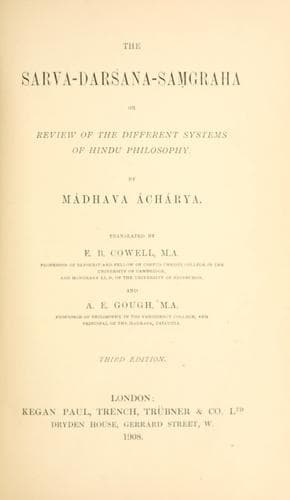
The Sarva-Darsana-Samgraha: Or, Review of the Different Systems of Hindu PhilosophyMadhava
ReligionEastern
The Sarva-Darsana-Samgraha: Or, Review of the Different Systems of Hindu Philosophy
Madhava
Philosophy, Hindu; Philosophy, Indic
If you say that "the object may still be perceived, inasmuch as it
will impress its form on the perception, even though the one may have
existed in a different moment from the other," this too will not hold.
For if you maintain that the knowledge acquired by perception has a
certain form impressed upon it, you are met by the impossibility of
explaining how a momentary perception can possess the power of
impressing a form; and if you say that it has no form impressed upon
it, you are equally met by the fact that, if we are to avoid
incongruity, there must be some definite condition to determine the
perception and knowledge in each several case. Thus by perception the
abstract consciousness, which before existed uninfluenced by the
external object, becomes modified under the form of a jar, &c., with a
definite reference to each man's personality [_i.e._, I see the jar],
and it is not merely the passive recipient of a reflection like a
mirror. Moreover, if the perception only reproduced the form of the
object, there would be an end of using such words as "far," "near,"
&c., of the objects.[44] Nor can you accept this conclusion, "as
exactly in accordance with your own views," because, in spite of all
our logic, the stubborn fact remains that we do use such phrases as
"the mountain is nearer" or "further," "long" or "large." Nor may you
say that "it is the object (which supplies the form) that really
possesses these qualities of being 'further,' &c., and they are
applied by a fashion of speech to the perception [though not really
belonging to it]"--because we do not find that this is the case in a
mirror [_i.e._, it does not become a _far_ reflection because it
represents a far object.] And again, as the perception produced by an
object follows it in assuming the form of blue, so too, if the object
be insentient, it ought equally to assume its form and so become
itself insentient. And thus, according to the proverb, "wishing to
grow, you have destroyed your root," and your cause has fallen into
hopeless difficulties.
Public-domain text, read in full here on John Shaqi.
Reviews
Reviews
No reviews yet
Be the first to share your thoughts on this work.
Join the Discussion
Join the discussion
Sign in to leave a comment or review.
Sign InorCreate an account