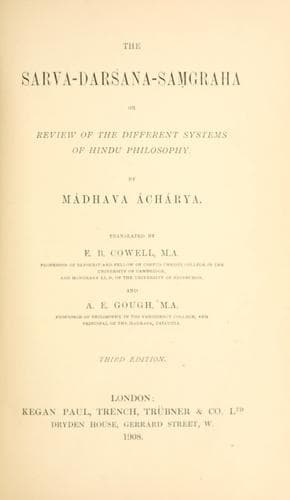
The Sarva-Darsana-Samgraha: Or, Review of the Different Systems of Hindu PhilosophyMadhava
ReligionEastern
The Sarva-Darsana-Samgraha: Or, Review of the Different Systems of Hindu Philosophy
Madhava
Philosophy, Hindu; Philosophy, Indic
If, in your wish to escape this difficulty, you assert that "the
perception does not follow the object in being insentient," then there
would be no perception that the object is insentient,[45] and so it is
a case of the proverb, "While he looks for one thing which he has
lost, another drops." "But what harm will it be if there is no
perception of a thing's being insentient?" [We reply], that if its
being insentient is not perceived, while its blue form is perceived,
the two may be quite distinct [and as different from each other as a
jar and cloth], or it may be a case of "indeterminateness" [so that
the two may be only occasionally found together, as smoke with fire].
And again, if insentience is not perceived contemporaneously with the
blue form, how could there then be conformity between them [so that
both the blue and the insentience should together constitute the
character of the thing?] We might just as well maintain that, on
perceiving a post, the unperceived universe entered into it as also
constituting its character.[46]
All this collection of topics for proof has been discussed at full
length by the Jaina authors, Pratápachandra and others, in the
_Prameyakamalamártaṇḍa_, &c., and is here omitted for fear of swelling
the book too much.
Therefore those who wish for the _summum bonum_ of man must not accept
the doctrine of Buddha, but rather honour only the Árhata doctrine.
The Arhat's nature has been thus described by Arhachchandra-súri,[47]
in his _Áptaniśchayálaṅkára_.
"The divine Arhat is the supreme lord, the omniscient one, who has
overcome all faults, desire, &c.,--adored by the three worlds, the
declarer of things as they are."
But may it not be objected that no such omniscient soul can enter the
path of proof, since none of the five affirmative proofs can be found
to apply, as has been declared by Tautátita [Bhaṭṭa Kumárila[48]]?
1. "No omniscient being is seen by the sense here in this world by
ourselves or others; nor is there any part of him seen which might
help us as a sign to infer his existence.
2. "Nor is there any injunction (_vidhi_) of scripture which reveals
an eternal omniscient one, nor can the meaning of the explanatory
passages (_arthaváda_) be applied here.
3. "His existence is not declared by those passages which refer to
quite other topics; and it cannot be contained in any emphatic
repetitions (_anuváda_), as it had never been mentioned elsewhere
before.
4. "An omniscient being who had a beginning can never be the subject
of the eternal Veda; and how can he be established by a made and
spurious Veda?
5. "Do you say that this omniscient one is accepted on his own word?
How can you establish either when they thus both depend on reciprocal
support?
6. "[If you say,] 'The saying is true because it was uttered by one
omniscient, and this proves the Arhat's existence;' how can either
point be established without some previously established foundation?
Public-domain text, read in full here on John Shaqi.
Reviews
Reviews
No reviews yet
Be the first to share your thoughts on this work.
Join the Discussion
Join the discussion
Sign in to leave a comment or review.
Sign InorCreate an account