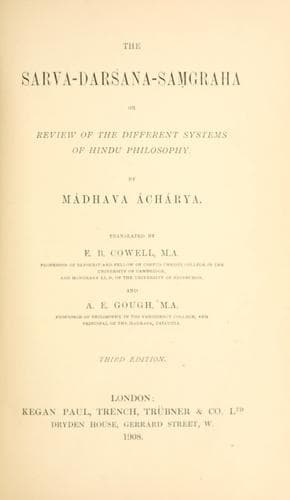
The Sarva-Darsana-Samgraha: Or, Review of the Different Systems of Hindu PhilosophyMadhava
ReligionEastern
The Sarva-Darsana-Samgraha: Or, Review of the Different Systems of Hindu Philosophy
Madhava
Philosophy, Hindu; Philosophy, Indic
7. "But they who accept a [supposed] omniscient on the baseless word
of a parviscient know nothing of the meaning of a real omniscient's
words.
8. "And again, if we now could see anything like an omniscient being,
we might have a chance of recognising him by the [well-known fourth]
proof, comparison (_upamána_).
9. "And the teaching of Buddha [as well as that of Jina], which
embraces virtue, vice, &c., would not be established as authoritative,
if there were not in him the attribute of omniscience,[49] and so on."
We reply as follows:--As for the supposed contradiction of an Arhat's
existence, derived from the failure of the five affirmative
proofs,--this is untenable, because there _are_ proofs, as inference,
&c., which _do_ establish[50] his existence. Thus any soul will become
omniscient when, (its natural capacity for grasping all objects
remaining the same), the hindrances to such knowledge are done away.
Whatever thing has a natural capacity for knowing any object, will,
when its hindrances to such knowledge are done away, actually know it,
just as the sense of vision cognises form, directly the hindrances of
darkness, &c., are removed. Now there _is_ such a soul, which has its
hindrances done away, its natural capacity for grasping all things
remaining unchanged; therefore there is an omniscient being. Nor is
the assertion unestablished that the soul has a natural capacity for
grasping all things; for otherwise the Mímáṃsist could not maintain
that a knowledge of all possible cases can be produced by the
authoritative injunction of a text,[51]--nor could there otherwise be
the knowledge of universal propositions, such as that in our favourite
argument, "All things are indeterminate from the very fact of their
existence" [and, of course, a follower of the Nyáya will grant that
universal propositions can be known, though he will dispute the truth
of this particular one]. Now it is clear that the teachers of the
Púrva Mímáṃsá accept the thesis that the soul has a natural capacity
for grasping all things; since they allow that a knowledge embracing
all things can be produced by the discussion of injunctions and
prohibitions, as is said [by Śabara in his commentary on the Sútras,
i. 1, 2], "A precept makes known the past, the present, the future,
the minute, the obstructed, the distant, &c." Nor can you say that "it
is impossible to destroy the obstructions which hinder the soul's
knowing all things," because we [Jainas] are convinced that there are
certain special means to destroy these obstructions, viz., the three
["gems"], right intuition, &c. By this charm also, all inferior
assaults of argument can be put to flight.
Public-domain text, read in full here on John Shaqi.
Reviews
Reviews
No reviews yet
Be the first to share your thoughts on this work.
Join the Discussion
Join the discussion
Sign in to leave a comment or review.
Sign InorCreate an account