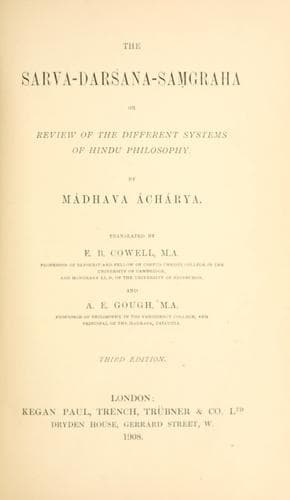
The Sarva-Darsana-Samgraha: Or, Review of the Different Systems of Hindu Philosophy — John Shaqi
The Sarva-Darsana-Samgraha: Or, Review of the Different Systems of Hindu PhilosophyMadhava
ReligionEastern
The Sarva-Darsana-Samgraha: Or, Review of the Different Systems of Hindu Philosophy
Madhava
Philosophy, Hindu; Philosophy, Indic
But the Naiyáyika may interpose, "You talk of the pure intelligence,
which, after all hindrances are done away, sees all objects, having
sense-perception at its height; but this is irrelevant, because there
can be no hindrance to the omniscient, as from all eternity he has
been always liberated." We reply that there is no proof of your
eternally liberated being. There cannot be an omniscient who is
eternally "liberated," from the very fact of his being "liberated,"
like other liberated persons,--since the use of the term "liberated"
necessarily implies the having been previously bound; and if the
latter is absent, the former must be too, as is seen in the case of
the ether. "But is not this being's existence definitely proved by his
being the maker of that eternal series of effects, the earth, &c.?
according to the well-known argument, 'the earth, &c., must have had a
maker, because they have the nature of effects, as a jar.'" This
argument, however, will not hold, because you cannot prove that they
have the nature of effects. You cannot establish this from the fact of
their being composed of parts, because this supposition falls upon the
horns of a dilemma. Does this "being composed of parts" mean (i.) the
being in contact with the parts; or (ii.) "the being in intimate
relation to the parts; or (iii.) the being produced from parts;" or
(iv.) the being a substance in intimate relation; or (v.) the being
the object of an idea involving the notion of parts?
Not _the first_, because it would apply too widely, as it would
include ether [since this, though not itself composed of parts, is in
contact with the parts of other things;] nor _the second_, because it
would similarly include genus, &c. [as this resides in a substance by
intimate relation, and yet itself is not composed of parts;] nor _the
third_, because this involves a term ("produced") just as much
disputed as the one directly in question;[52] nor _the fourth_,
because its neck is caught in the pillory of the following
alternative:--Do you mean by your phrase used above that it is to be a
substance, and to have something else in intimate relation to
itself,--or do you mean that it must have intimate relation to
something else, in order to be valid for your argument? If you say the
former, it will equally apply to ether, since this is a substance, and
has its qualities resident in it by intimate relation; if you say the
latter, your new position involves as much dispute as the original
point, since you would have to prove the existence of intimate
relation in the parts, or the so-called "intimate causes," which you
mean by "something else." We use these terms in compliance with your
terminology; but, of course, from our point of view, we do not allow
such a thing as "intimate relation," as there is no proof of its
existence.
Public-domain text, read in full here on John Shaqi.
Reviews
Reviews
No reviews yet
Be the first to share your thoughts on this work.
Join the Discussion
Join the discussion
Sign in to leave a comment or review.
Sign InorCreate an account