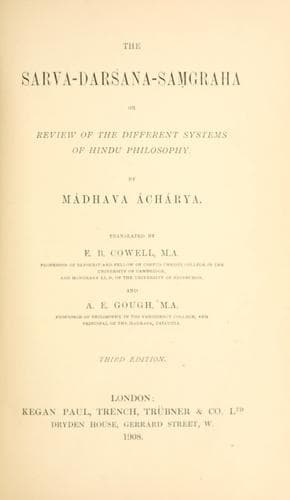
The Sarva-Darsana-Samgraha: Or, Review of the Different Systems of Hindu PhilosophyMadhava
ReligionEastern
The Sarva-Darsana-Samgraha: Or, Review of the Different Systems of Hindu Philosophy
Madhava
Philosophy, Hindu; Philosophy, Indic
Nor can _the fifth_ alternative be allowed, because this would reach
too far, as it would include soul, &c., since soul can be the object
of an idea involving the notion of parts, and yet it is acknowledged
to be not an effect.[53] Nor can you maintain that the soul may still
be indiscerptible in itself, but by reason of its connection with
something possessing parts may itself become metaphorically the object
of an idea involving the notion of parts, because there is a mutual
contradiction in the idea of that which has no parts and that which is
all-pervading, just as the atom [which is indiscerptible but not
all-pervading].
And, moreover, is there only one maker? Or, again, is he independent?
In the former case your position will apply too far, as it will extend
erroneously to palaces, &c., where we see for ourselves the work of
many different men, as carpenters, &c., and [in the second case] if
all the world were produced by this one maker, all other agents would
be superfluous. As it has been said in the _Vítarágastuti_, or "Praise
of Jina"--
1. "There is one eternal maker for the world, all-pervading,
independent, and true; they have none of these inextricable delusions,
whose teacher art _thou_."
And again--
2. "There is here no maker acting by his own free will, else his
influence would extend to the making of a mat. What would be the use
of yourself or all the artisans, if Íśwara fabricates the three
worlds?"
Therefore it is right to hold, as we do, that omniscience is produced
when the hindrances are removed by the three means before alluded to.
Nor need the objection be made that "right intuition," &c., are
impossible, as there is no other teacher to go to,--because this
universal knowledge can be produced by the inspired works of former
omniscient Jinas. Nor is our doctrine liable to the imputation of such
faults as _Anyonyáśrayatá_,[54] &c., because we accept an eternal
succession of revealed doctrines and omniscient teachers, like the
endless series of seed springing from shoot and shoot from seed. So
much for this preliminary discussion.
The well-known triad called the three gems, right intuition, &c., are
thus described in the _Paramágamasára_ (which is devoted to the
exposition of the doctrines of the Arhats)--"Right intuition, right
knowledge, right conduct are the path of liberation." This has been
thus explained by Yogadeva:--
Public-domain text, read in full here on John Shaqi.
Reviews
Reviews
No reviews yet
Be the first to share your thoughts on this work.
Join the Discussion
Join the discussion
Sign in to leave a comment or review.
Sign InorCreate an account