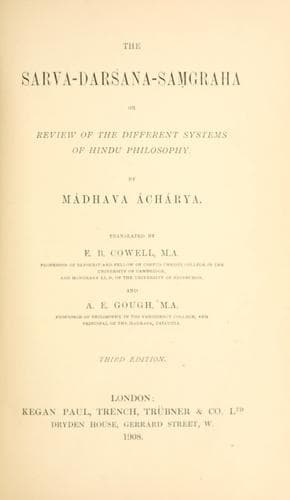
The Sarva-Darsana-Samgraha: Or, Review of the Different Systems of Hindu PhilosophyMadhava
ReligionEastern
The Sarva-Darsana-Samgraha: Or, Review of the Different Systems of Hindu Philosophy
Madhava
Philosophy, Hindu; Philosophy, Indic
(_a._) When the meaning of the predicaments, the soul, &c., has been
declared by an Arhat in exact accordance with their reality, absolute
faith in the teaching, _i.e._, the entire absence of any contrary
idea, is "right intuition." And to this effect runs the
_Tattvártha-sútra_, "Faith in the predicaments[55] is right
'intuition.'" Or, as another definition gives it, "Acquiescence in the
predicaments declared by a Jina is called 'right faith;' it is
produced either by natural character or by the guru's instruction."
"Natural character" means the soul's own nature, independent of
another's teaching; "instruction" is the knowledge produced by the
teaching of another in the form of explanation, &c.
(_b._) "Right knowledge" is a knowledge of the predicaments, soul,
&c., according to their real nature, undisturbed by any illusion or
doubt; as it has been said--
"That knowledge, which embraces concisely or in detail the
predicaments as they actually are, is called 'right knowledge' by the
wise."
This knowledge is fivefold as divided into _mati_, _śruta_, _avadhi_,
_manas-paryáya_, and _kevala_; as it has been said, "_Mati_, _ś_ruta,
_avadhi_, _manas-paryáya_, and _kevala_, these are knowledge." The
meaning of this is as follows:--
1. _Mati_ is that by which one cognises an object through the
operation of the senses and the mind, all obstructions of knowledge
being abolished.
2. _Śruta_ is the clear knowledge produced by _mati_, all the
obstructions of knowledge being abolished.
3. _Avadhi_ is the knowledge of special objects caused by the
abolition of hindrances, which is effected by "right intuition,"
&c.[56]
4. _Manas-paryáya_ is the clear definite knowledge of another's
thoughts, produced by the abolition of all the obstructions of
knowledge caused by the veil of envy.
5. _Kevala_ is that pure unalloyed knowledge for the sake of which
ascetics practise various kinds of penance.
The first of these (_mati_) is not self-cognised, the other four are.
Thus it has been said--
"True knowledge is a proof which nothing can overthrow, and which
manifests itself as well as its object; it is both supersensuous and
itself an object of cognition, as the object is determined in two
ways."
But the full account of the further minute divisions must be got from
the authoritative treatise above-mentioned.
(_c._) "Right conduct" is the abstaining from all actions tending to
evil courses by one who possesses faith and knowledge, and who is
diligent in cutting off the series of actions and their effects which
constitutes mundane existence. This has been explained at length by
the Arhat--
1. "Right conduct is described as the entire relinquishment of
blamable impulses; this has been subjected to a fivefold division, as
the 'five vows,' _ahiṃsá_, _súnṛita_, _asteya_, _brahmacharyá_, and
_aparigraha_.[57]
2. "The 'vow' of _ahiṃsá_ is the avoidance of injuring life by any act
of thoughtlessness in any movable or immovable thing.
Public-domain text, read in full here on John Shaqi.
Reviews
Reviews
No reviews yet
Be the first to share your thoughts on this work.
Join the Discussion
Join the discussion
Sign in to leave a comment or review.
Sign InorCreate an account