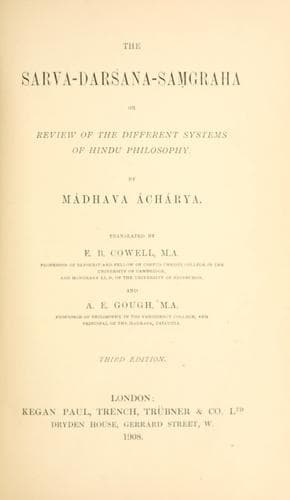
The Sarva-Darsana-Samgraha: Or, Review of the Different Systems of Hindu Philosophy — John Shaqi
The Sarva-Darsana-Samgraha: Or, Review of the Different Systems of Hindu PhilosophyMadhava
ReligionEastern
The Sarva-Darsana-Samgraha: Or, Review of the Different Systems of Hindu Philosophy
Madhava
Philosophy, Hindu; Philosophy, Indic
3. "A kind, salutary, and truthful speech is called the 'vow' of
_súnṛita_. That truthful speech is not truthful, which is unkind to
others and prejudicial.
4. "The not taking what is not given is declared to be the 'vow' of
_asteya_; the external life is a man's property, and, when it is
killed, it is killed by some one who seizes it.
5. "The 'vow' of _brahmacharyá_ (chastity) is eighteen-fold, viz., the
abandonment of all desires,[58] heavenly or earthly, in thought, word,
and deed, and whether by one's own action or by one's consent, or by
one's causing another to act.
6. "The 'vow' of _aparigraha_ is the renouncing of all delusive
interest in everything that exists not; since bewilderment of thought
may arise from a delusive interest even in the unreal.
7. "When carried out by the five states of mind in a fivefold order,
these great 'vows' of the world produce the eternal abode."
The full account of the five states of mind (_bhávaná_) has been given
in the following passage [of which we only quote one śloka]--
"Let him carry out the 'vow' of _súnṛita_ uninterruptedly by the
abstinence from laughter, greed, fear, and anger, and by the
deliberate avoidance of speech,"[59]--and so forth.
These three, right intuition, right knowledge, and right conduct, when
united, produce liberation, but not severally; just as, in the case of
an elixir, it is the knowledge of what it is, faith in its virtues,
and the actual application of the medicine,[60] united, which produce
the elixir's effect, but not severally.
Here we may say concisely that the _tattvas_ or predicaments are two,
_jíva_ and _ajíva_; the soul, _jíva_, is pure intelligence; the
non-soul, _ajíva_, is pure non-intelligence. Padmanandin has thus
said--
"The two highest predicaments are 'soul' and 'non-soul;'
'discrimination' is the power of discriminating these two, in one who
pursues what is to be pursued, and rejects what is to be rejected. The
affection, &c., of the agent are to be rejected; these are objects for
the non-discriminating; the supreme light [of knowledge] is alone to
be pursued, which is defined as _upayoga_."
_Upayoga_ [or "the true employment of the soul's activities"] takes
place when the vision of true knowledge recognises the manifestation
of the soul's innate nature; but as long as the soul, by the bond of
_pradeśa_ and the mutual interpenetration of form which it produces
[between the soul and the body], considers itself as identified with
its actions [and the body which they produce], knowledge should rather
be defined as "the cause of its recognising that it is other than
these."[61]
Public-domain text, read in full here on John Shaqi.
Reviews
Reviews
No reviews yet
Be the first to share your thoughts on this work.
Join the Discussion
Join the discussion
Sign in to leave a comment or review.
Sign InorCreate an account