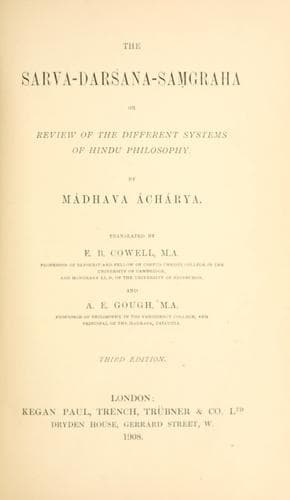
The Sarva-Darsana-Samgraha: Or, Review of the Different Systems of Hindu PhilosophyMadhava
ReligionEastern
The Sarva-Darsana-Samgraha: Or, Review of the Different Systems of Hindu Philosophy
Madhava
Philosophy, Hindu; Philosophy, Indic
Thus obstructions (_ávaraṇa_)[78] cloud the knowledge and intuition,
as a cloud obscures the sun or a shade the lamp. This is (_a_)
_jnánávaraṇa_, or (_b_) _darśanávaraṇa_. (_c_) An object recognised as
simultaneously existing or non-existing produces mingled pleasure and
pain, as licking honey from a sword's edge,--this is _vedaníya_. (_d_)
A delusion (_mohaníya_) in intuition produces want of faith in the
Jaina categories, like association with the wicked; delusion in
conduct produces want of self-restraint, like intoxication. (_e_)
_Áyus_ produces the bond of body, like a snare.[79] (_f_) _Náman_, or
"the name," produces various individual appellations, as a painter
paints his different pictures. (_g_) _Gotra_ produces the idea of
noble and ignoble, as the potter fashions his pots. (_h_) _Antaráya_
produces obstacles to liberality, &c., as the treasurer hinders the
king by considerations of economy.
Thus is the _prakṛiti-bandha_ eightfold, being denominated as the
eight _múla-prakṛitis_, with subdivisions according to the different
actions of the various subject-matter.
And thus has Umáswáti-váchakáchárya[80] declared: "The first kind of
_bandha_ consists of obstructions of the knowledge and the intuition,
_vedaníya_, _mohaníya_, _áyus_, _náman_, _gotra_, and _antaráya_;" and he
has also reckoned up the respective subdivisions of each as five, nine,
twenty-eight, four, two, forty, two, and fifteen. All this has been
explained at full length in the _Vidyánanda_ and other works, and here is
omitted through fear of prolixity.
2. _Sthiti._ As the milk of the goat, cow, buffalo, &c., have continued
unswerving from their sweet nature for so long a period, so the first
three _múla-prakṛitis_, _jnánávaraṇa_, &c., and the last, _antaráya_, have
not swerved from their respective natures even through the period
described in the words, "_sthiti_ lasts beyonds crores of crores of
periods of time measured by thirty _ságaropamas_."[81] This continuance is
_sthiti_.
3. _Anubháva._ As in the milk of goats, cows, buffaloes, &c., there
exists, by its rich or poor nature, a special capacity for
producing[82] its several effects, so in the different material bodies
produced by our actions there exists a special capacity (_anubháva_)
for producing their respective effects.
4. _Pradeśa._ The _bandha_ called _pradeśa_ is the entrance into the
different parts of the soul by the masses, made up of an endless
number of parts, of the various bodies which are developed by the
consequences of actions.
Public-domain text, read in full here on John Shaqi.
Reviews
Reviews
No reviews yet
Be the first to share your thoughts on this work.
Join the Discussion
Join the discussion
Sign in to leave a comment or review.
Sign InorCreate an account