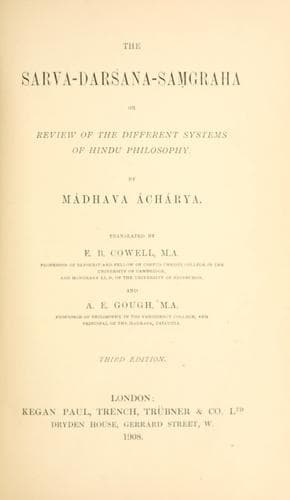
The Sarva-Darsana-Samgraha: Or, Review of the Different Systems of Hindu PhilosophyMadhava
ReligionEastern
The Sarva-Darsana-Samgraha: Or, Review of the Different Systems of Hindu Philosophy
Madhava
Philosophy, Hindu; Philosophy, Indic
_Saṃvara_ is the stopping of _ásrava_--that by which the influence of
past actions (_karman_) is stopped from entering into the soul. It is
divided into _gupti_, _samiti_, &c. _Gupti_ is the withdrawal of the
soul from that "impulse" (_yoga_) which causes mundane existence,--it
is threefold, as relating to body, speech, or mind. _Samiti_ is the
acting so as to avoid injury to all living beings. This is divided
into five kinds, as _íryá_,[83] _bháshá_, &c., as has been explained
by Hemachandra.
1. "In a public highway, kissed by the sun's rays, to walk
circumspectly so as to avoid injuring living beings, this the good
call _íryá_.
2. "Let him practise[84] a measured utterance in his intercourse with
all people; this is called _bháshá-samiti_, dear to the restrainers of
speech.
3. "The food which the sage takes, ever free from the forty-two faults
which may accrue to alms, is called the _eshaṇá-samiti_.[85]
4. "Carefully looking at it and carefully seating himself upon it, let
him take a seat, &c., set it down, and meditate,--this is called the
_ádána-samiti_.
5. "That the good man should carefully perform his bodily evacuations
in a spot free from all living creatures,[86]--this is the
_utsarga-samiti_.[87] Hence _samvara_ has been etymologically analysed
as that which closes (_sam_ + _vṛiṇoti_) the door of the stream of
_ásrava_,[88] as has been said by the learned, '_Ásrava_ is the cause
of mundane existence, _saṃvara_ is the cause of liberation;[89] this
is the Árhat doctrine in a handful; all else is only the amplification
of this.'"
_Nirjará_ is the causing the fruit of past actions to decay by
self-mortification, &c.; it destroys by the body the merit and demerit
of all the previously performed actions, and the resulting happiness
and misery; "self-mortification" means the plucking out of the hair,
&c. This _nirjará_ is twofold,[90] "temporary" (_yathákála_) and
ancillary (_aupakramaṇika_). It is "temporary" as when a desire is
dormant in consequence of the action having produced its fruit, and at
that particular time, from this completion of the object aimed at,
_nirjará_ arises, being caused by the consumption of the desire, &c.
But when, by the force of asceticism, the sage turns all actions into
means for attaining his end (liberation), this is the _nirjará_ of
actions. Thus it has been said: "From the decaying of the actions
which are the seeds of mundane existence, _nirjará_ arises, which is
twofold, _sakámá_ and _akámá_. That called _sakámá_ belongs to
ascetics, the _akámá_ to other embodied spirits."[91]
Public-domain text, read in full here on John Shaqi.
Reviews
Reviews
No reviews yet
Be the first to share your thoughts on this work.
Join the Discussion
Join the discussion
Sign in to leave a comment or review.
Sign InorCreate an account