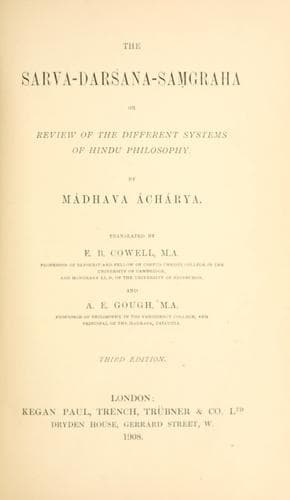
The Sarva-Darsana-Samgraha: Or, Review of the Different Systems of Hindu PhilosophyMadhava
ReligionEastern
The Sarva-Darsana-Samgraha: Or, Review of the Different Systems of Hindu Philosophy
Madhava
Philosophy, Hindu; Philosophy, Indic
_Moksha._ Since at the moment of its attainment there is an entire
absence of all future actions, as all the causes of bondage (false
perception, &c.) are stopped,[92] and since all past actions are
abolished in the presence of the causes of _nirjará_, there arises the
absolute release from all actions,--this is _moksha_; as it has been
said: "_Moksha_ is the absolute release from all actions by the decay
(_nirjará_) of the causes of bondage and of existence."
Then the soul rises upward to the end of the world. As a potter's
wheel, whirled by the stick and hands, moves on even after these have
stopped, until the impulse is exhausted, so the previous repeated
contemplations of the embodied soul for the attainment of _moksha_
exert their influence even after they have ceased, and bear the soul
onward to the end of the world; or, as the gourd, encased with clay,
sinks in the water, but rises to the surface when freed from its
encumbrance, so the soul, delivered from works, rises upward by its
isolation,[93] from the bursting of its bonds like the elastic seed of
the castor-oil plant, or by its own native tendency like the flame.
"Bondage" is the condition of being unseparated, with a mutual
interpenetration of parts [between the soul and the body]; _saṅga_ is
merely mutual contact. This has been declared as follows:--
"[Liberation] is unhindered, from the continuance of former impulses,
from the absence of _saṅga_, from the cutting of all bonds, and from
the natural development of the soul's own powers of motion, like the
potter's wheel, the gourd with its clay removed, the seed of the
castor-oil plant, or the flame of fire."
Hence they recite a śloka:--
"However often they go away, the planets return, the sun,
moon, and the rest;
"But never to this day have returned any who have gone to
Álokákáśa."
Others hold _moksha_ to be the abiding in the highest regions, the
soul being absorbed in bliss, with its knowledge unhindered and itself
untainted by any pain or impression thereof.
Others hold nine _tattwas_, adding "merit" and "demerit" to the
foregoing seven,--these two being the causes of pleasure and pain.
This has been declared in the _Siddhánta_, "_Jíva_, _ajíva_, _puṇya_,
_pápa_, _ásrava_, _saṃvara_, _nirjaraṇa_, _bandha_, and _moksha_, are
the nine _tattwas_." As our object is only a summary, we desist here.
Here the Jainas everywhere introduce their favourite logic called the
_sapta-bhaṅgí-naya_,[94] or the system of the seven paralogisms, "may
be, it is," "may be, it is not," "may be, it is and it is not," "may
be, it is not predicable," "may be, it is, and yet not predicable,"
"may be, it is not, and not predicable," "may be, it is and it is not,
and not predicable." All this Anantavírya has thus laid down:--
1. "When you wish to establish a thing, the proper course is to say
'may be, it is;' when you wish to deny it, 'may be, it is not.'
Public-domain text, read in full here on John Shaqi.
Reviews
Reviews
No reviews yet
Be the first to share your thoughts on this work.
Join the Discussion
Join the discussion
Sign in to leave a comment or review.
Sign InorCreate an account