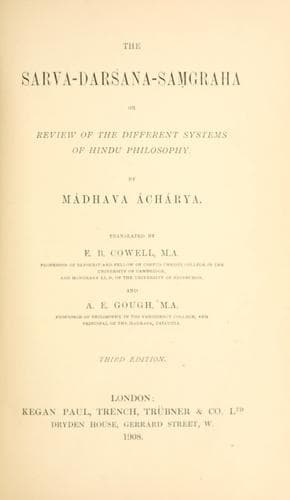
The Sarva-Darsana-Samgraha: Or, Review of the Different Systems of Hindu Philosophy — John Shaqi
The Sarva-Darsana-Samgraha: Or, Review of the Different Systems of Hindu PhilosophyMadhava
ReligionEastern
The Sarva-Darsana-Samgraha: Or, Review of the Different Systems of Hindu Philosophy
Madhava
Philosophy, Hindu; Philosophy, Indic
2. "When you desire to establish each in turn, let your procedure
likewise embrace both; when you wish to establish both at once, let it
be declared 'indescribable' from the impossibility to describe it.
3. "The fifth process is enjoined when you wish to establish the first
as well as its indescribableness; when the second as well as its
indescribableness, the occasion for the sixth process arises.
4. "The seventh is required when all three characters are to be
employed simultaneously."
_Syát_, "may be," is here an indeclinable particle in the form of a
part of a verb, used to convey the idea of indeterminateness; as it
has been said--
"This particle _syát_ is in the form of a verb, but, from
its being connected with the sense, it denotes
indeterminateness in sentences, and has a qualifying effect
on the implied meaning."
If, again, the word _syát_ denoted determinateness, then it would be
needless in the phrase, "may be, it is;" but since it really denotes
indeterminateness, "may be, it is," means "it is somehow;" _syát_,
"may be," conveys the meaning of "somehow," _kathaṃchit_; and so it is
not really useless. As one has said--
"The doctrine of the _syád-váda_ arises from our everywhere rejecting
the idea of the absolute;[95] it depends on the _sapta-bhaṅgí-naya_,
and it lays down the distinction between what is to be avoided and to
be accepted."
If a thing absolutely exists, it exists altogether, always,
everywhere, and with everybody, and no one at any time or place would
ever make an effort to obtain or avoid it, as it would be absurd to
treat what is already present as an object to be obtained or avoided.
But if it be relative (or indefinite), the wise will concede that at
certain times and in certain places any one may seek or avoid it.
Moreover, suppose that the question to be asked is this: "Is _being_
or _non-being_ the real nature of the thing?" The real nature of the
thing cannot be _being_, for then you could not properly use the
phrase, "It is a pot" (_ghaṭósti_), as the two words "is" and "pot"
would be tautological; nor ought you to say, "It is not a pot," as the
words thus used would imply a direct contradiction; and the same
argument is to be used in other questions.[96] As it has been
declared--
"It must not be said 'It is a pot,' since the word 'pot'
implies 'is;'
"Nor may you say 'it is not a pot,' for existence and
non-existence are mutually exclusive," &c.
Public-domain text, read in full here on John Shaqi.
Reviews
Reviews
No reviews yet
Be the first to share your thoughts on this work.
Join the Discussion
Join the discussion
Sign in to leave a comment or review.
Sign InorCreate an account