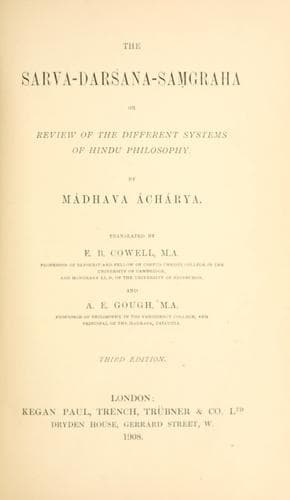
The Sarva-Darsana-Samgraha: Or, Review of the Different Systems of Hindu Philosophy — John Shaqi
The Sarva-Darsana-Samgraha: Or, Review of the Different Systems of Hindu PhilosophyMadhava
ReligionEastern
The Sarva-Darsana-Samgraha: Or, Review of the Different Systems of Hindu Philosophy
Madhava
Philosophy, Hindu; Philosophy, Indic
Hence it follows that there is no other hell than mundane pain
produced by purely mundane causes, as thorns, &c.; the only Supreme is
the earthly monarch whose existence is proved by all the world's
eyesight; and the only Liberation is the dissolution of the body. By
holding the doctrine that the soul is identical with the body, such
phrases as "I am thin," "I am black," &c., are at once intelligible,
as the attributes of thinness, &c., and self-consciousness will reside
in the same subject [the body]; like and the use of the phrase "my
body" is metaphorical "the head of Ráhu" [Ráhu being really _all
head_].
All this has been thus summed up--
In this school there are four elements, earth, water, fire, and air;
And from these four elements alone is intelligence produced,--
Just like the intoxicating power from kiṇwa, &c., mixed together;
Since in "I am fat," "I am lean," these attributes[11] abide in the
same subject,
And since fatness, &c., reside only in the body,[12] it alone is the
soul and no other,
And such phrases as "my body" are only significant metaphorically.
"Be it so," says the opponent; "your wish would be gained if
inference, &c., had no force of proof; but then they have this force;
else, if they had not, then how, on perceiving smoke, should the
thoughts of the intelligent immediately proceed to fire; or why, on
hearing another say, 'There are fruits on the bank of the river,' do
those who desire fruit proceed at once to the shore?"
All this, however, is only the inflation of the world of fancy.
Those who maintain the authority of inference accept the _sign_ or
middle term as the causer of knowledge, which middle term must be
found in the minor and be itself invariably connected with the
major.[13] Now this invariable connection must be a relation destitute
of any condition accepted or disputed;[14] and this connection does
not possess its power of causing inference by virtue of its
_existence_, as the eye, &c., are the cause of perception, but by
virtue of its being _known_. What then is the means of this
connection's being known?
Public-domain text, read in full here on John Shaqi.
Reviews
Reviews
No reviews yet
Be the first to share your thoughts on this work.
Join the Discussion
Join the discussion
Sign in to leave a comment or review.
Sign InorCreate an account