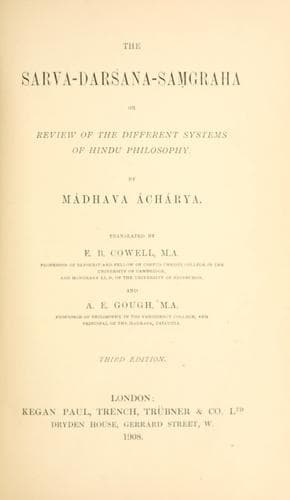
The Sarva-Darsana-Samgraha: Or, Review of the Different Systems of Hindu Philosophy — John Shaqi
The Sarva-Darsana-Samgraha: Or, Review of the Different Systems of Hindu PhilosophyMadhava
ReligionEastern
The Sarva-Darsana-Samgraha: Or, Review of the Different Systems of Hindu Philosophy
Madhava
Philosophy, Hindu; Philosophy, Indic
We will first show that it is not _perception_. Now perception is
held to be of two kinds, external and internal [_i.e._, as produced by
the external senses, or by the inner sense, mind]. The former is not
the required means; for although it is possible that the actual
contact of the senses and the object will produce the knowledge of the
particular object thus brought in contact, yet as there can never be
such contact in the case of the past or the future, the universal
proposition[15] which was to embrace the invariable connection of the
middle and major terms in every case becomes impossible to be known.
Nor may you maintain that this knowledge of the universal proposition
has the general class as its object, because if so, there might arise
a doubt as to the existence of the invariable connection in this
particular case[16] [as, for instance, in this particular smoke as
implying fire].
Nor is internal perception the means, since you cannot establish that
the mind has any power to act independently towards an external
object, since all allow that it is dependent on the external senses,
as has been said by one of the logicians, "The eye, &c., have their
objects as described; but mind externally is dependent on the others."
Nor can _inference_ be the means of the knowledge of the universal
proposition, since in the case of this inference we should also
require another inference to establish it, and so on, and hence would
arise the fallacy of an _ad infinitum_ retrogression.
Nor can _testimony_ be the means thereof, since we may either allege
in reply, in accordance with the Vaiśeshika doctrine of Kaṇáda, that
this is included in the topic of inference; or else we may hold that
this fresh proof of testimony is unable to leap over the old barrier
that stopped the progress of inference, since it depends itself on
the recognition of a _sign_ in the form of the language used in the
child's presence by the old man;[17] and, moreover, there is no more
reason for our believing on another's word that smoke and fire are
invariably connected, than for our receiving the _ipse dixit_ of Manu,
&c. [which, of course, we Chárvákas reject].
And again, if testimony were to be accepted as the only means of the
knowledge of the universal proposition, then in the case of a man to
whom the fact of the invariable connection between the middle and
major terms had not been pointed out by another person, there could be
no inference of one thing [as fire] on seeing another thing [as
smoke]; hence, on your own showing, the whole topic of inference for
oneself[18] would have to end in mere idle words.
Public-domain text, read in full here on John Shaqi.
Reviews
Reviews
No reviews yet
Be the first to share your thoughts on this work.
Join the Discussion
Join the discussion
Sign in to leave a comment or review.
Sign InorCreate an account