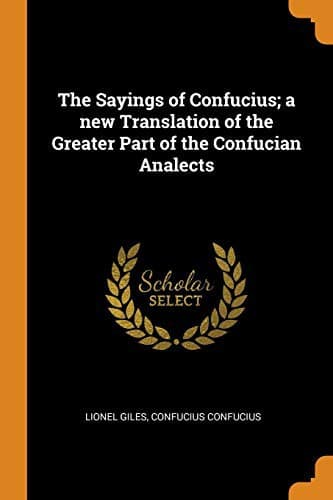
The Sayings of Confucius: A New Translation of the Greater Part of the Confucian AnalectsConfucius
ReligionEastern
The Sayings of Confucius: A New Translation of the Greater Part of the Confucian Analects
Confucius
Ethics -- China; Philosophy, Chinese
[4] The hidden meaning of this saying is made clear by the context
to be found in Ssŭ-ma Ch‘ien's biography of Confucius. The Prince of
Wei at this time was the young man mentioned on p. 128 as holding the
throne against his own father. By so doing he had in some sort inverted
the relationship which should have subsisted between them, and each was
in a false position, the father being deprived of his proper parental
dignity, and the son no longer "doing his duty as a son" (see p. 41).
Confucius then is administering a veiled rebuke to the young ruler, for
in saying that the first reform necessary is the correct definition
of names, he implies in effect that the terms "father" and "son,"
among others, should be made to resume their proper significance. An
alternative rendering of _chêng ming_ as "rectification of the written
character," though backed by the great authority of M. Chavannes, can
only be described as feeble and far-fetched, and has been ably confuted
by Herr Franke in the _T'oung Pao_ for July, 1906.
[5] Confucius is of course merely insisting on the principle of
division of labour, and not by any means depreciating the value of
husbandry or other useful arts. It is not the ruler's business to make
himself proficient in these, because the task of governing and setting
an example to the governed will claim all his attention. Compare
Plato's disapproval of πολυπραγμοσύνη, and Confucius' remarks on his
own skill in various arts (p. 88).
[6] The weak ruler of the Lu State (510-494 B.C.), who lost the
services of Confucius by his infatuation in accepting the insidious
gift of eighty beautiful singing-girls from the Ch‘i State. See
Introduction, p. 16.
[7] Shê was a district of the Ch‘u State, which Confucius visited in
488 B.C. The following anecdote, told by T‘an Kung, is a striking
illustration of the above saying. Travelling with his disciples,
the Master came across a woman weeping and wailing beside a grave,
and inquired the cause of her grief. "Alas!" she replied. "My
father-in-law was killed here by a tiger; after that, my husband; and
now my son has perished by the same death."--"But why, then, do you
not go elsewhere?"--"The government here is not harsh," answered the
woman.--"There!" cried the Master, turning to his disciples, "remember
that. Bad government is worse than a tiger."
[8] A small city in Lu.
[9] Legge translates: "When rulers love to observe the rules of
propriety (!), the people respond readily to the calls on them for
service." All the other translators seem likewise to have missed the
point, which is elsewhere insisted on by Confucius--that no man is fit
to govern others who cannot govern himself. On the meaning of _li_, see
Introduction, pp. 30 _seqq._, and note on p. 60.
[10] A legendary Emperor.
[11] This saying might have come straight from the mouth of a Taoist
philosopher. Nor is it the only place where Confucius seems to advocate
quietism. Cf. p. 108.
Public-domain text, read in full here on John Shaqi.
Reviews
Reviews
No reviews yet
Be the first to share your thoughts on this work.
Join the Discussion
Join the discussion
Sign in to leave a comment or review.
Sign InorCreate an account