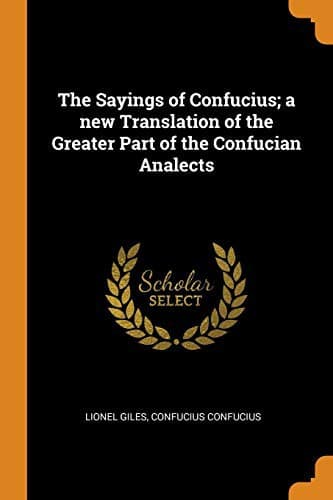
The Sayings of Confucius: A New Translation of the Greater Part of the Confucian AnalectsConfucius
ReligionEastern
The Sayings of Confucius: A New Translation of the Greater Part of the Confucian Analects
Confucius
Ethics -- China; Philosophy, Chinese
[12] Literally, "a minister of the altars to the spirits of the land
and grain"; i.e. a direct vassal of the Emperor, and responsible only
to him.
[13] An ancient historiographer, of whom very little is known.
[14] The head of the Chi clan mentioned above.
[15] Wu‘Chêng means "Martial city," so called from its impregnable
position. Tzŭ Yu, when appointed governor, had succeeded in weaning the
people from their warlike propensities, and in introducing the milder
arts of peace. This is what made the Master glad, though he could not
help being amused at the application of the loftiest principles to such
a tiny community. About ancient Chinese music we know unfortunately
next to nothing, but it seems to have played as important a part under
the Chou dynasty as in Plato's ideal State.
[16] That is to say, the ruler will always keep the welfare of his
people in view, but without indulging in indiscriminate largess. The
ever-increasing doles of money and corn with which the Roman Emperors
were obliged to buy the favour of the populace would thus have fallen
under the condemnation of Confucius.
[17] The "four evil things" really turn out to be reducible to two,
namely (1) Cruelty--covering the first three; and (2) Meanness.
INDIVIDUAL VIRTUE
The Master said: Is he not a princely man[1]--he who is never vexed
that others know him not?
True virtue[2] rarely goes with artful speech and insinuating looks.
At home, a young man should show the qualities of a son; abroad, those
of a younger brother. He should be circumspect but truthful. He should
have charity in his heart for all men, but associate only with the
virtuous. After thus regulating his conduct, his surplus energy should
be devoted to literary culture.
In the matter of food and lodging, the nobler type of man does not seek
mere repletion and comfort. He is earnest in his affairs and cautious
in his speech, and frequents virtuous company for his own improvement.
He may be called one truly bent on the study of virtue.[3]
Mêng I Tzŭ[4] asked for a definition of filial piety. The Master said:
It consists in there being no falling off.[5]--Fan Ch‘ih was driving
the Master's carriage some time after, when the latter told him,
saying: Mêng I Tzŭ asked me about filial piety, and I answered that it
consisted in there being no falling off.--Fan Ch'ih said: What did you
mean?--The Master replied: That parents should be served in the proper
spirit while living, buried with the proper rites after death, and
worshipped thereafter with the proper sacrifices.
Mêng Wu Po[6] asked for a definition of filial piety. The Master said:
There is filial piety when parents are spared all anxiety about their
children except when they happen to fall sick.[7]
Public-domain text, read in full here on John Shaqi.
Reviews
Reviews
No reviews yet
Be the first to share your thoughts on this work.
Join the Discussion
Join the discussion
Sign in to leave a comment or review.
Sign InorCreate an account