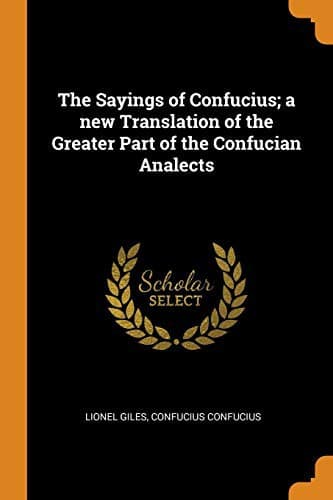
The Sayings of Confucius: A New Translation of the Greater Part of the Confucian Analects — John Shaqi
The Sayings of Confucius: A New Translation of the Greater Part of the Confucian AnalectsConfucius
ReligionEastern
The Sayings of Confucius: A New Translation of the Greater Part of the Confucian Analects
Confucius
Ethics -- China; Philosophy, Chinese
Tzŭ Yu put a question on the subject of filial piety. The Master said:
The filial piety of to-day reduces itself to the mere question of
maintenance. Yet this is something in which even our dogs and horses
have a share.[8] Without the feeling of reverence, what is there to
distinguish the two cases?
Tzŭ Hsia also asked about filial piety. The Master said: It can hardly
be gauged from mere outward acts.[9] When there is work to be done,
to relieve one's elders of the toil; or when there is wine and food,
to cause them to partake thereof--is _this_ to be reckoned filial
piety?[10]
Tzŭ Kung inquired about the higher type of man. The Master replied: The
higher type of man is one who acts before he speaks, and professes only
what he practises.
The Master said: The higher type of man is catholic in his sympathy
and free from party bias; the lower type of man is biassed and
un-sympathetic.
A man without charity in his heart--what has he to do with ceremonies?
A man without charity in his heart--what has he to do with music?[11]
Lin Fang inquired as to the prime essential in ceremonial observances.
The Master said: Ah, that is a great question indeed! In all rites,
simplicity is better than extravagance; in mourning for the dead,
heartfelt sorrow is better than punctiliousness.
The Master said: The true gentleman is never contentious. If a spirit
of rivalry is anywhere unavoidable, it is at a shooting-match. Yet
even here he courteously salutes his opponents before taking up
his position, and again when, having lost, he retires to drink the
forfeit-cup. So that even when competing he remains a true gentleman.
It is the spirit of charity which makes a locality good to dwell in. He
who selects a neighbourhood without regard to this quality cannot be
considered wise.
Only he who has the spirit of goodness within him is really able either
to love or to hate.
The princely man never for a single instant quits the path of virtue;
in times of storm and stress he remains in it as fast as ever.
The nobler sort of man in his progress through the world has neither
narrow predilections nor obstinate antipathies. What he follows is the
line of duty.
The nobler sort of man is proficient in the knowledge of his duty; the
inferior man is proficient only in money-making.
In serving his father and mother, a son may use gentle remonstrance;
if he sees that they pay no heed, he should not desist, but merely
increase in deference; if his pains are thrown away, he must show no
resentment.
While one's parents are alive, one should not travel to a distance; if
one must travel, it should be in a fixed direction.[12]
The age of one's parents should always be kept in mind--on the one
hand, as a subject for rejoicing; on the other, as a cause for alarm.
The wise man will be slow to speak but quick to act.
Public-domain text, read in full here on John Shaqi.
Reviews
Reviews
No reviews yet
Be the first to share your thoughts on this work.
Join the Discussion
Join the discussion
Sign in to leave a comment or review.
Sign InorCreate an account