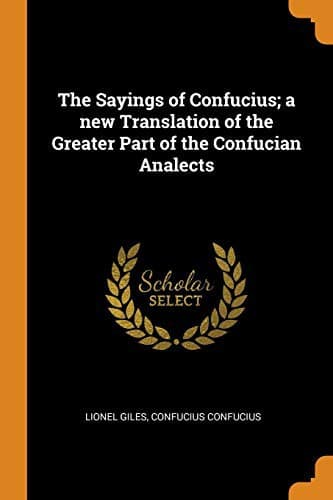
The Sayings of Confucius: A New Translation of the Greater Part of the Confucian AnalectsConfucius
ReligionEastern
The Sayings of Confucius: A New Translation of the Greater Part of the Confucian Analects
Confucius
Ethics -- China; Philosophy, Chinese
Tzŭ Chang asked, saying: The Prime Minister Tzŭ Wên[13] held office
three times, but showed no joy; he lost it three times, but testified
no concern. When he ceased to be Prime Minister, he was careful to
explain the political situation to his successor. What is your opinion
of him?--
The Master said: He was loyal and conscientious.[14]--Had he not the
highest degree of moral virtue?--That I do not know; how can one judge
of his moral virtue?--Tzŭ Chang continued: When Ts‘ui Tzŭ[15] slew
the Prince of Ch‘i, Ch‘ên Wên Tzŭ, though the possessor of ten teams
of war-horses, forsook his wealth and turned his back on the country.
Having come to another state, he said: "Here they are as bad as our own
minister Ts‘ui Tzŭ," and departed. And he repeated this proceeding each
time that he came to a new state.[16] What is your opinion of him?--The
Master said: He was pure and incorruptible.--Had he not the highest
degree of virtue?--I cannot say; how is one to judge?
The Master said: When the solid outweighs the ornamental, we have
boorishness; when the ornamental outweighs the solid, we have
superficial smartness. Only from a proper blending of the two will the
higher type of man emerge. All men are born good. He who loses his
goodness and yet lives is lucky to escape.
Better than one who knows what is right is one who is fond of what is
right; and better than one who is fond of what is right is one who
delights in what is right.
Fan Ch‘ih asked in what wisdom consisted. The Master said: Make
righteousness in human affairs your aim, treat all supernatural beings
with respect, but keep aloof from them--then you may be called wise.
Asked about moral virtue, he replied: The virtuous man thinks of
the difficult thing[17] first, and makes material advantage only a
secondary consideration. This may be said to constitute moral virtue.
The Master said: The man of knowledge finds pleasure in the sea,
the man of virtue finds pleasure in the mountains.[18] For the man
of knowledge is restless and the man of virtue is calm. The man of
knowledge is happy, and the man of virtue is long-lived.
The higher type of man, having gathered wide objective knowledge from
the branches of polite learning, will regulate the whole by the inner
rule of conduct,[19] and will thus avoid overstepping the limit.
That virtue is perfect which adheres to a constant mean. It has long
been rare amongst men.
Tzŭ Kung asked: What would you say of the man who conferred benefits
far and wide on the people and was able to be the salvation of all?
Would you pronounce him a man of moral virtue?--Of moral virtue? said
the Master. Nay, rather, of divine virtue.[20] Even Yao and Shun were
still striving to attain this height.
The man of moral virtue, wishing to stand firm himself, will lend
firmness unto others; wishing himself to be illuminated, he will
illuminate others. To be able to do to others as we would be done
by[21]--this is the true domain of moral virtue.
Public-domain text, read in full here on John Shaqi.
Reviews
Reviews
No reviews yet
Be the first to share your thoughts on this work.
Join the Discussion
Join the discussion
Sign in to leave a comment or review.
Sign InorCreate an account