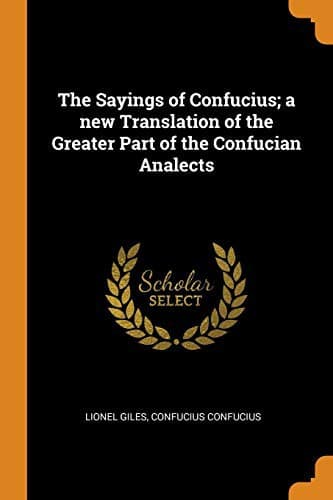
The Sayings of Confucius: A New Translation of the Greater Part of the Confucian AnalectsConfucius
ReligionEastern
The Sayings of Confucius: A New Translation of the Greater Part of the Confucian Analects
Confucius
Ethics -- China; Philosophy, Chinese
It has not been my lot to see a divine man; could I see a princely
man, that would satisfy me. It has not been my lot to see a thoroughly
virtuous man; could I see a man possessing honesty of soul, that would
satisfy me. Is it possible there should be honesty of soul in one who
pretends to have what he has not; who, when empty, pretends to be
overflowing; who, when in want, pretends to be in affluence?
The higher type of man is calm and serene; the inferior man is
constantly agitated and worried.
With sincerity and truth unite a desire for self-culture. Lay down
your life rather than quit the path of virtue. Enter not the state
which is tottering to its fall. Abide not in the state where sedition
is rampant. When law obtains in the Empire, let yourself be seen; when
lawlessness reigns, retire into obscurity. In a state governed on right
principles, poverty and low station are things to be ashamed of; in an
ill-governed state, riches and rank are things to be ashamed of.
The man of wisdom does not vacillate; the man of natural goodness does
not fret; the man of valour does not fear.
Yen Yüan inquired as to the meaning of true goodness. The Master said:
The subdual of self, and reversion to the natural laws governing
conduct--this is true goodness. If a man can for the space of one day
subdue his selfishness and revert to natural laws, the whole world will
call him good. True goodness springs from a man's own heart. How can it
depend on other men?--Yen Yüan said: Kindly tell me the practical rule
to be deduced from this.--The Master replied: Do not use your eyes,
your ears, your power of speech or your faculty of movement without
obeying the inner law of self-control.[22]--Yen Yüan said: Though I am
not quick in thought or act, I will make it my business to carry out
this precept.
Chung Kung inquired as to the meaning of true goodness. The Master
said: When out of doors, behave as though you were entertaining a
distinguished guest; in ruling the people, behave as though you were
officiating at a solemn sacrifice; what you would not wish done to
yourself, do not unto others.[23] Then in public as in private life
you will excite no ill-will. Chung Kung said: Though I am not quick in
thought or act, I will make it my business to carry out this precept.
Ssŭ-ma Niu inquired as to the meaning of true goodness. The Master
said: The truly good man is slow of speech.[24]--Slowness of speech!
Is this what goodness consists in?--The Master said: Does not the
difficulty of deciding what it is right to _do_ necessarily imply
slowness to _speak_?
Ssŭ-ma Niu asked for a definition of the princely man. The Master said:
The princely man is one who knows neither grief nor fear.--Absence of
grief and fear! Is this the mark of a princely man?--The Master said:
If on searching his heart he finds no guilt, why should he grieve? of
what should he be afraid?
Public-domain text, read in full here on John Shaqi.
Reviews
Reviews
No reviews yet
Be the first to share your thoughts on this work.
Join the Discussion
Join the discussion
Sign in to leave a comment or review.
Sign InorCreate an account