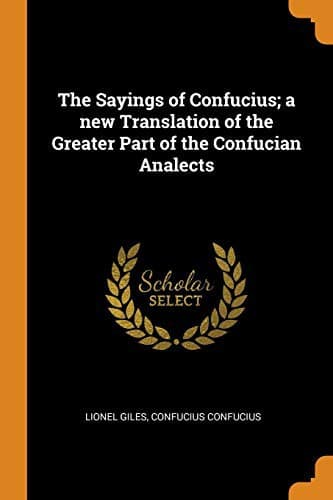
The Sayings of Confucius: A New Translation of the Greater Part of the Confucian AnalectsConfucius
ReligionEastern
The Sayings of Confucius: A New Translation of the Greater Part of the Confucian Analects
Confucius
Ethics -- China; Philosophy, Chinese
[15] This accounts for men taking no notice of him. Most so-called
sages start with grandiose ideals and high-flown utterances, in order
to attract attention.
[16] This is rightly considered to be one of the moat important of the
Master s sayings, because it gives the clue to his whole philosophy and
view of life. The "connecting thread," as we learn from another passage
(see p. 118), is simply the moral life, which consists in being true
to oneself and good to one's neighbour. Confucius wished to impress
upon his disciple that he was no mere amasser of knowledge nor lover
of learning for learning's sake. The one thing necessary, in his eyes,
was to be able to lead, in the highest sense of the word, a moral life,
and this was the real object of all learning, the end and aim of all
knowledge. Throughout the Analects, as we have already seen, the usual
word for "learning" always means or implies the study of virtue, the
striving after self-improvement. Like Socrates, Confucius was purely
a moral philosopher, and would certainly have rejected the sharp
distinction we draw nowadays between mental and moral science.
[17] A rebellious official in the Chin State. On more than one occasion
in his career, Confucius made it plain that he declined to be bound
by narrow convention or hampered by the fear of what people might say
of him. To keep clear of bad associates was no doubt an excellent
principle, but Confucius may have seen some justification for Pi Hsi's
course of action, and in any case he was no longer of an age to be
easily corrupted by evil communications. Knowing that rules were never
meant to be so rigid as to admit of no exceptions, he felt it his
primary duty to go where he could do good. Cf. the visit to Nan Tzŭ (p.
83), the mere idea of which would have horrified an ordinary teacher of
morality.
MISCELLANEOUS SAYINGS
The Master said: To learn, and to practise on occasion what one has
learnt--is this not true pleasure? The coming of a friend from a
far-off land--is this not true joy?
Make conscientiousness and sincerity your grand object. Have no friends
not equal to yourself. If you have done wrong, be not ashamed to make
amends.
Observe the bent of a man's will when his father is alive, and his
actions after his father is dead. If during the three years of mourning
he does not swerve from his father's principles, he may be pronounced a
truly filial son.
The Odes[1] are three hundred in number, but their purport may be
summed up in a word:--Have no depraved thoughts.
Observe a man's actions; scrutinise his motives; take note of the
things that give him pleasure. How then can he hide from you what he
really is?
Acquire new knowledge whilst thinking over the old, and you may become
a teacher of others.
The higher type of man is not like a vessel which is designed for some
Special use.[2]
Study without thought is vain; thought without study is perilous.
Absorption in the study of the supernatural is most harmful.
Public-domain text, read in full here on John Shaqi.
Reviews
Reviews
No reviews yet
Be the first to share your thoughts on this work.
Join the Discussion
Join the discussion
Sign in to leave a comment or review.
Sign InorCreate an account