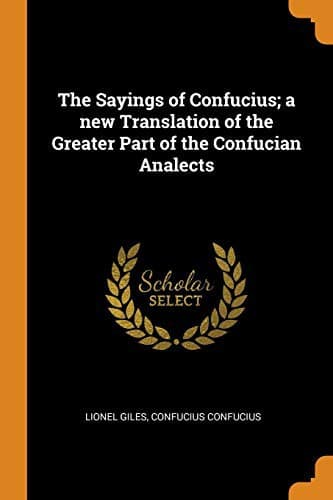
The Sayings of Confucius: A New Translation of the Greater Part of the Confucian AnalectsConfucius
ReligionEastern
The Sayings of Confucius: A New Translation of the Greater Part of the Confucian Analects
Confucius
Ethics -- China; Philosophy, Chinese
Yu, shall I tell you what true knowledge is? When you know, to know
that you know, and when you do not know, to know that you do not
know--that is true knowledge.
Tzŭ Chang was studying with a view to official preferment. The Master
said to him: Among the various things you hear said, reserve your
judgment on those which seem doubtful, and give cautious utterance
to the rest: then you will seldom fall into error. Among the various
things you see done, set aside those which seem dangerous, and
cautiously put the others into practice: then you will seldom have
occasion for repentance. If you seldom err in your speech, and seldom
have to repent of your actions, official preferment will come of itself.
The Master said: I do not see how a man without sincerity can be good
for anything. How can a cart or carriage be made to go without yoke or
cross-bar?
To sacrifice to a spirit with which you have nothing to do, is mere
servility.
To shirk your duty when you see it before you, shows want of moral
courage.
Some one inquired as to the meaning of the Great Sacrifice. The Master
said: I do not know. He who knew its meaning would find it as easy to
govern the Empire as to look upon this (pointing to his palm).[3]
Wang-sun Chia[4] asked, saying: What means the adage, "Better be civil
to the kitchen-god than to the god of the inner sanctum"?--The Master
replied: The adage is false. He who sins against Heaven can rely on the
intercession of none.
The Master said: He who serves his prince with all the proper ceremony
will be accounted by men a flatterer.
It is bootless to discuss accomplished facts, to protest against things
past remedy, to find fault with things bygone.
How am I to regard one who has rank without liberality, who performs
ceremonies without reverence, who approaches the rites of mourning
without sorrow?
Men's faults are characteristic.[5] It is by observing a man's faults
that one may come to know his virtues.
Having heard the True Way in the morning what matters it if one should
come to die at night?
The scholar who is bent on studying the principles of virtue, yet is
ashamed of bad clothes and coarse food, is not yet fit to receive
instruction.
Instead of being concerned that you have no office, be concerned to
think how you may fit yourself for office. Instead of being concerned
that you are not known, seek to be worthy of being known.
When you see a good man, think of emulating him; when you see a bad
man, examine your own heart.
The ancients hesitated to give their thoughts utterance: they were
afraid that their actions might not be equal to their words.
Few are those who err on the side of self-restraint.[6]
Virtue cannot live in solitude: neighbours are sure to grow up around
it.[7]
Chi Wên Tzŭ[8] used to reflect thrice before he acted. When told of
this, the Master said: Twice would do.
The Master said: Alas! I have never met a man who could see his own
faults and arraign himself at the bar of his own conscience.
Public-domain text, read in full here on John Shaqi.
Reviews
Reviews
No reviews yet
Be the first to share your thoughts on this work.
Join the Discussion
Join the discussion
Sign in to leave a comment or review.
Sign InorCreate an account