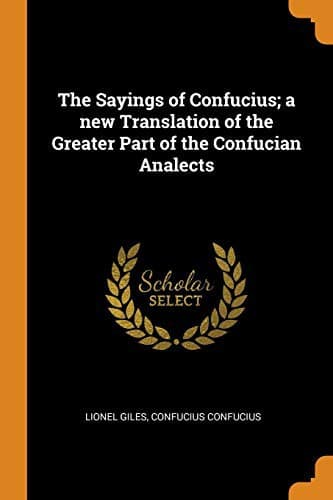
The Sayings of Confucius: A New Translation of the Greater Part of the Confucian AnalectsConfucius
ReligionEastern
The Sayings of Confucius: A New Translation of the Greater Part of the Confucian Analects
Confucius
Ethics -- China; Philosophy, Chinese
[4] Prime Minister of the Wei State, who suspected Confucius of coming
to seek office, and took this means of hinting that the real power lay
with himself and not with the Duke.
[5] After some hesitation, I have adopted this clever rendering of
Mr. Ku Hung-ming, as being the only one that fits well with the next
sentence.
[6] A few other renderings of this sentence will illustrate at once the
elasticity of the Chinese language, and the difficulty of making it
flow into European moulds.--LEGGE: "The cautious seldom err." WADE: "It
seldom happens that a man errs through excess of moderation." JENNINGS:
"Those who keep within restraints are seldom losers." KU HUNG-MING: "He
who wants little seldom goes wrong."
[7] I.e. virtue begets virtue.
[8] A member of the great Chi family, who held office in Lu.
[9] The proper allowance for an officer in his station.
[10] As being, in the end, the moat natural and least troublesome route
to take.
[11] It is impossible to find an exact equivalent for this negative
expression "non-yieldingness," "non-humility." But the dominant
idea is one of _selfishness_, and therefore such renderings as
"insubordination" (Legge), "frowardnes" (Wade), "excess" (Ku
Hung-ming), are rather wide off the mark.
[12] For note on _li_, see p. 60. Here again it is the inner sense of
moral proportion and harmony, which prevents any quality from being
carried to excess. Not a translator but has come to grief over this
word, though Mr. Ku is not so far off with "judgment." That, however,
makes of it an intellectual principle rather than what it realty is--a
moral sense.
[13] Literally, "learning." See notes on pp. 53 and 91.
[14] The commentators seem right in their explanation, that a man's
defects are usually redeemed by certain corresponding qualities; when
even these are absent, the case is hopeless.
[15] This is the best I can make of a vexed passage. Legge's
translation is poor, but he is right with regard to the lesson
intended--"that repeated acquisitions individually small will
ultimately amount to much, and that the learner is never to give over."
[16] Men are known in time of adversity.
[17] Because the family was very poor and could ill afford to bear the
expense. It is not the least of this great man's titles to fame that he
resolutely opposed the tide of popular sentiment in this matter, and
could see the iniquity of sacrificing the living to the dead, even when
the funeral of his dearly beloved disciple was in question. The moral
courage of such an attitude in a country like China, where religion
is largely connected with the propitiation of spirits, can hardly be
overestimated.
[18] Literally, "reach righteousness."
[19] Before subscribing to the popular judgment. Cf. saying on p. 103.
[20] I.e. mere passivity, as advocated by the Taoists, will not do.
Public-domain text, read in full here on John Shaqi.
Reviews
Reviews
No reviews yet
Be the first to share your thoughts on this work.
Join the Discussion
Join the discussion
Sign in to leave a comment or review.
Sign InorCreate an account