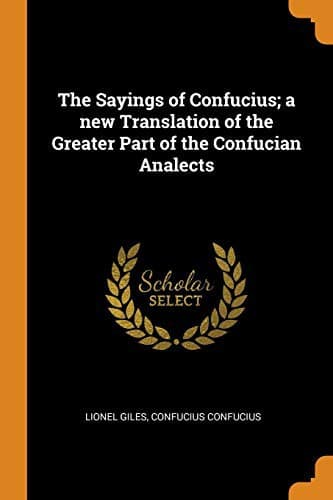
The Sayings of Confucius: A New Translation of the Greater Part of the Confucian AnalectsConfucius
ReligionEastern
The Sayings of Confucius: A New Translation of the Greater Part of the Confucian Analects
Confucius
Ethics -- China; Philosophy, Chinese
[21] These numerical categories are hardly more than a conventional
form into which the Chinese are fond of throwing ethical and other
teaching. Needless to say, they are not to be considered as exhaustive.
[22] Confucius, as we have seen (p. 86), puts himself in this second
class.
[23] The difference lies in the _set purpose_ of studying virtue in a
systematic way, and not merely doing right when occasion offers.
[24] "The will to learn" is a necessarily vague rendering of the
equally vague original. It means here a desire for moral culture, which
is nothing else than the development of that inner sense of harmony
and proportion (_li_) referred to on p. 99. Good instincts, according
to Confucius, are not enough to produce virtues, unless they are
supplemented by careful cultivation of this moral sense.
[25] A magnificent array of vestments and chalices will no more
constitute a true ceremony than a number of musical instruments alone,
without the brain of a composer, can produce music. The whole value
of a ceremony is determined by the state of mind of the person who
performs it.
PERSONALIA
In his moments of leisure, the Master's manner was uniformly cheerful
and smiling.
If the Master happened to be dining beside one who was in mourning for
his parents, he never ate a full meal. He never sang on any day in the
course of which he had been bewailing a death.
The Master would never talk about prodigies, feats of strength, crime,
or supernatural beings.[1]
The Master made four things the subject of his teaching: a knowledge of
literature and the arts, conduct, conscientiousness and truthfulness.[2]
The Master fished with a line but not with a net. When he went out with
bow and arrow, he only shot at birds on the wing.
If the Master happened to be with singers, and they sang a piece well,
he would get them to repeat it, when he would also join in the song
himself.
The Master was affable, yet grave; stern, but not fierce; attentive in
his behaviour, and yet calm.
The Master seldom spoke of money-making, of the laws of Providence, or
of moral virtue.[3]
There were four words of which the Master barred the use: he would have
no "shall's," no "must's," no "certainly's," no "I's".[4]
Whenever the Master saw a person in mourning, or in official robes, or
one who was blind, he would at once rise from his seat, even though the
other were his junior; or if he passed them in the street, he would
quicken his step.[5]
Public-domain text, read in full here on John Shaqi.
Reviews
Reviews
No reviews yet
Be the first to share your thoughts on this work.
Join the Discussion
Join the discussion
Sign in to leave a comment or review.
Sign InorCreate an account