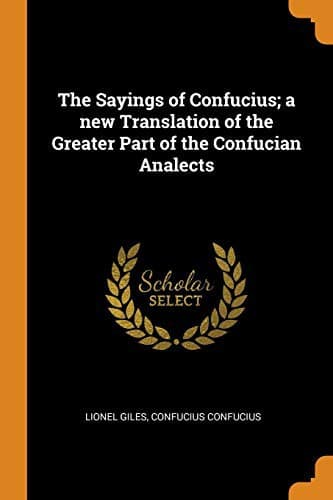
The Sayings of Confucius: A New Translation of the Greater Part of the Confucian AnalectsConfucius
ReligionEastern
The Sayings of Confucius: A New Translation of the Greater Part of the Confucian Analects
Confucius
Ethics -- China; Philosophy, Chinese
Once when the Master was lying seriously ill, Tzŭ Lu got the disciples
to act the part of Ministers of State.[6] In an interval of his
sickness, Confucius said: What a long time Yu has been keeping up
this imposture! In pretending to have ministers attendant on me when
I have none, whom am I deceiving? Am I deceiving God? But apart from
that, is it not better that I should breathe my last in the arms of my
disciples, than that I should die in the midst of officials? And after
all, though I may not be accorded the honour of a public funeral, I am
not dying out on the high road.
The Master wished to settle among the nine eastern tribes. Some one
said: How can you? They are savages.--The Master replied: If a higher
type of man dwelt in their midst, how could their savage condition last?
Confucius in his native village was simple and unassuming. He gave the
impression of being no great speaker. In the ancestral temple and at
Court he spoke fluently, but with a certain reserve.
At Court, he spoke to the ministers of lower rank with frankness
and affability. To those of higher rank he spoke quietly, but with
decision. In the presence of his Sovereign, he seemed full of awe, but
at the same time grave and collected.
When employed by the Prince in the reception of distinguished visitors,
his expression would change, and his legs seemed to bend under him.
Standing in the presence of the visitors, he saluted them with clasped
hands, turning about from right to left, and keeping the skirt of his
robe properly adjusted, back and front. He then hastened forward with
arms extended like the wings of a bird. When a visitor departed, he
would report in that sense to the Prince, saying: "The visitor is not
looking back."[7]
When he entered the gate of the palace, he seemed to bend his body as
though the gate were not large enough to let him pass. He did not stand
in the middle of the doorway, nor in passing through did he set foot
on the threshold. When he passed the Prince's throne, his expression
seemed to change, his legs seemed to bend under him, and words seemed
to fail him. Holding up his robe with both hands, he ascended the dais,
his body slightly bent, and holding his breath as though he dared not
breathe. When he came out from his audience and had descended the first
step, his countenance lost its anxious expression, and he looked serene
and happy. When he reached the bottom of the steps, he hastened away
with his arms outstretched like wings; but when he got back to his
place, he still seemed full of awe.
He carried the Prince's regalia with body slightly bent, as though he
could hardly support its weight; he raised it to the height of his
head, and lowered it again to the height of his chest. His countenance
indicated nervousness, and he dragged his feet as though something held
them to the ground.
In offering presents as an ambassador, his appearance was sedate.
At a private audience, he wore a pleased look.
Public-domain text, read in full here on John Shaqi.
Reviews
Reviews
No reviews yet
Be the first to share your thoughts on this work.
Join the Discussion
Join the discussion
Sign in to leave a comment or review.
Sign InorCreate an account