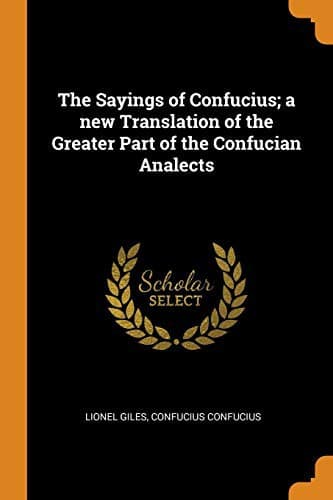
The Sayings of Confucius: A New Translation of the Greater Part of the Confucian Analects — John Shaqi
The Sayings of Confucius: A New Translation of the Greater Part of the Confucian AnalectsConfucius
ReligionEastern
The Sayings of Confucius: A New Translation of the Greater Part of the Confucian Analects
Confucius
Ethics -- China; Philosophy, Chinese
Mien, a blind musician,[13] having called on Confucius, the Master said
to him when he came to a flight of steps: "Here are the steps"; and
when he came to the mat which was spread for him: "Here is your mat."
When all the visitors were seated, the Master told him who they were,
saying: So-and-so is sitting here, so-and-so is sitting there. After
Mien had gone, Tzŭ Chang asked, saying: Is it the proper thing to speak
thus to a musician?--The Master replied: Assuredly it is right to give
this help to a blind man.
The people of Ch‘i sent a band of singing-girls as a present to the
Duke of Lu, and Chi Huan Tzŭ accepted the gift. For three days after
that no Court was held, and Confucius departed.[14]
[1] Under these circumstances, it is easy to imagine how edified he
would be by the modern daily press, which subsists almost entirely on
these very topics.
[2] I am unable to improve on this rendering, which is borrowed from
Mr. Ku Hung-ming.
[3] This statement--at least as regards moral virtue (jên)-- seems
hopelessly at variance with the evidence of the Analects. Perhaps
no more is meant than that he was unwilling to dogmatise on such a
delicate subject. On p. 72, for instance, he refuses to judge whether
certain disciples have true moral virtue or not.
[4] This is Mr. Jennings's interpretation, and it seems to me the
simplest and best.
[5] Thus showing, says a commentator, his sympathy with sorrow, his
respect for rank, his tenderness for the afflicted. Quickening his pace
was also a mark of respect.
[6] Just as though Confucius had his own Court and entourage, like a
feudal prince. This probably happened during his exile in some foreign
state, where the chance of his obtaining a public funeral would
doubtless be proportionate to the display made by his followers.
[7] "The ways of China, it appears, were much the same anciently as
now. A guest turns round and bows repeatedly in leaving, and the host
cannot return to his place till these salutations are ended."--LEGGE.
[8] The Chinese of that date dispensed with chairs, as the Japanese
have done up to the present time.
[9] The point is, that in his solicitude for others Confucius never
thought of his own loss, not that he was indifferent to the suffering
of animals.
[10] Some of the minute details given above cannot but strike us as
rather ridiculous. Two points, however, must be borne in mind: (1)
that the customs and ceremonial belonging to any one age or country
will always at first sight appear strange and laughable to the men of
any other age and country; (2) that Confucius himself cannot be held
responsible for the excessive zeal which prompted admiring disciples to
portray his personal habits with such embarrassing fidelity. How many
philosophers would come equally well through such an ordeal?
[11] Literally, "dish and platter business," i.e. things pertaining to
sacrificial worship.
[12] By order of the Duke.
Public-domain text, read in full here on John Shaqi.
Reviews
Reviews
No reviews yet
Be the first to share your thoughts on this work.
Join the Discussion
Join the discussion
Sign in to leave a comment or review.
Sign InorCreate an account