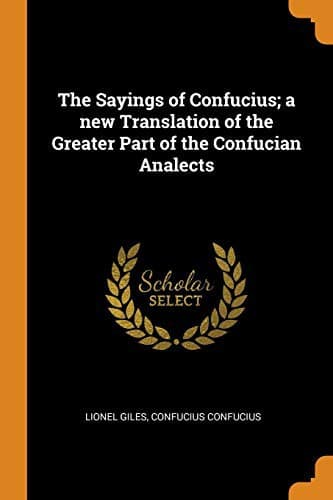
The Sayings of Confucius: A New Translation of the Greater Part of the Confucian AnalectsConfucius
ReligionEastern
The Sayings of Confucius: A New Translation of the Greater Part of the Confucian Analects
Confucius
Ethics -- China; Philosophy, Chinese
Hence, though he may be said to have returned to his
native state with flying colours, he took no further active part in its
administration, but devoted the rest of his life to literary labours
which have added materially to his fame. Such were the collecting
and editing of certain old national ballads known to us as the Odes,
and the penning of the Spring and Autumn Annals of Lu, which may be
regarded as the first real record of authentic facts, as opposed to the
mere string of speeches and eulogies which we find in the miscalled
Book of History.
To this closing period, too, are to be referred most of the sayings
given in the present volume. These, together with the invaluable
biography by Ssŭ-ma Ch'ien, which is largely built upon them, form the
only really reliable source of information about Confucius and his
doctrines. The Chinese title _Lun Yü_ may be rendered "Conversations"
or "Discussions," but neither is a very apt description of the work,
which contains very little discussion in the ordinary sense. It
consists in fact almost wholly of detached _obiter dicta_, or replies
to questions put by various disciples on subjects chiefly moral or
personal. These sayings were once supposed to have been collected and
committed to writing by the immediate disciples of Confucius, but Legge
has shown sufficient reason to believe that they were transmitted
orally at first, and did not take the form in which we have them
until at least two generations after the Master's death. Nor must it
be imagined that they represent the _ipsissima verba_ of Confucius.
No man could have made offhand remarks in such a crisp, concise and
epigrammatic style. A translation, in which brevity has again and again
to be sacrificed to smoothness and lucidity, hardly allows the European
reader to form any idea of the glittering compactness of these sayings
in the original. So far from having been uttered impromptu, they
appear to have been repeatedly ground and polished, and shorn of every
redundancy, until they shone like diamonds fresh from the hands of the
cutter. At the same time, as expressing the essence of what the Master
thought and the substance of what he said, it is with good reason that
they are to be found inscribed on hundreds of thousands of scrolls
and tablets in every corner of the Empire. These gems, however, are
unsorted. As in most Chinese philosophical works, there is very little
attempt at orderly arrangement; even such a rough classification as
will be found in this volume is absent. This is not necessarily to be
regarded as a defect: jewels jumbled in a heap often have a charm which
they lack when strung symmetrically into a necklace. The only danger
is that unwary readers, looking in vain for a beginning, a middle
and an end, may jump to the conclusion that Confucius himself was
merely a master of casual apophthegms; they may very easily miss the
connecting principles which serve to bind the Confucian teachings into
one rounded system.
Public-domain text, read in full here on John Shaqi.
Reviews
Reviews
No reviews yet
Be the first to share your thoughts on this work.
Join the Discussion
Join the discussion
Sign in to leave a comment or review.
Sign InorCreate an account