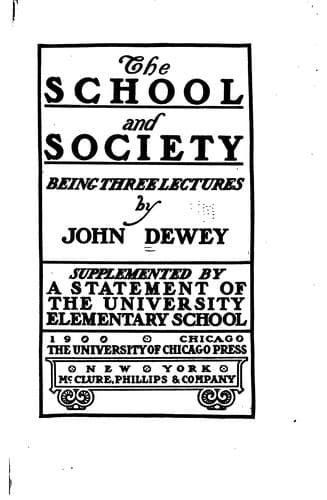
The School and Society: Being three lecturesDewey, John
Philosophy
The School and Society: Being three lectures
Dewey, John
Education; Education -- Philosophy; Educational psychology; University of Chicago. University Elementary School
of children doing practical work in weaving which involved the use of
the spinning wheel, worked out the diagrams of the direction of forces
concerned in treadle and wheel, and the ratio of velocities between
wheel and spindle. In the same manner, the plants with which the child
has to do in cooking, afford the basis for a concrete interest in
botany, and may be taken and studied by themselves. In a certain school
in Boston science work for months was centered in the growth of the
cotton plant, and yet something new was brought in every day. We hope to
do similar work with all the types of plants that furnish materials for
sewing and weaving. These examples will suggest, I hope, the relation
which the laboratories bear to the rest of the school.
The drawing and music, or the graphic and auditory arts, represent the
culmination, the idealization, the highest point of refinement of all
the work carried on. I think everybody who has not a purely literary
view of the subject recognizes that genuine art grows out of the work of
the artisan. The art of the Renaissance was great, because it grew out
of the manual arts of life. It did not spring up in a separate
atmosphere, however ideal, but carried on to their spiritual meaning
processes found in homely and everyday forms of life. The school should
observe this relationship. The merely artisan side is narrow, but the
mere art, taken by itself, and grafted on from without, tends to become
forced, empty, sentimental. I do not mean, of course, that all art work
must be correlated in detail to the other work of the school, but simply
that a spirit of union gives vitality to the art, and depth and richness
to the other work. All art involves physical organs, the eye and hand,
the ear and voice; and yet it is something more than the mere technical
skill required by the organs of expression. It involves an idea, a
thought, a spiritual rendering of things; and yet it is other than any
number of ideas by themselves. It is a living union of thought and the
instrument of expression. This union is symbolized by saying that in the
ideal school the art work might be considered to be that of the shops,
passed through the alembic of library and museum into action again.
Public-domain text, read in full here on John Shaqi.
Reviews
Reviews
No reviews yet
Be the first to share your thoughts on this work.
Join the Discussion
Join the discussion
Sign in to leave a comment or review.
Sign InorCreate an account