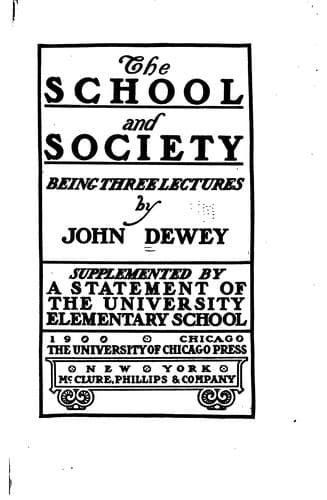
The School and Society: Being three lecturesDewey, John
Philosophy
The School and Society: Being three lectures
Dewey, John
Education; Education -- Philosophy; Educational psychology; University of Chicago. University Elementary School
Take the textile room as an illustration of such a synthesis. I am
talking about a future school, the one we hope, some time, to have. The
basal fact in that room is that it is a workshop, doing actual things in
sewing, spinning, and weaving. The children come into immediate
connection with the materials, with various fabrics of silk, cotton,
linen and wool. Information at once appears in connection with these
materials; their origin, history, their adaptation to particular uses,
and the machines of various kinds by which the raw materials are
utilized. Discipline arises in dealing with the problems involved, both
theoretical and practical. Whence does the culture arise? Partly from
seeing all these things reflected through the medium of their scientific
and historic conditions and associations, whereby the child learns to
appreciate them as technical achievements, as thoughts precipitated in
action; and partly because of the introduction of the art idea into the
room itself. In the ideal school there would be something of this sort:
first, a complete industrial museum, giving samples of materials in
various stages of manufacture, and the implements, from the simplest to
the most complex, used in dealing with them; then a collection of
photographs and pictures illustrating the landscapes and the scenes from
which the materials come, their native homes, and their places of
manufacture. Such a collection would be a vivid and continual lesson in
the synthesis of art, science, and industry. There would be, also,
samples of the more perfect forms of textile work, as Italian, French,
Japanese, and Oriental. There would be objects illustrating motives of
design and decoration which have entered into production. Literature
would contribute its part in its idealized representation of the
world-industries, as the Penelope in the Odyssey—a classic in literature
only because the character is an adequate embodiment of a certain
industrial phase of social life. So, from Homer down to the present
time, there is a continuous procession of related facts which have been
translated into terms of art. Music lends its share, from the Scotch
song at the wheel to the spinning song of Marguerite, or of Wagner’s
Senta. The shop becomes a pictured museum, appealing to the eye. It
would have not only materials, beautiful woods and designs, but would
give a synopsis of the historical evolution of architecture in its
drawings and pictures.
Public-domain text, read in full here on John Shaqi.
Reviews
Reviews
No reviews yet
Be the first to share your thoughts on this work.
Join the Discussion
Join the discussion
Sign in to leave a comment or review.
Sign InorCreate an account