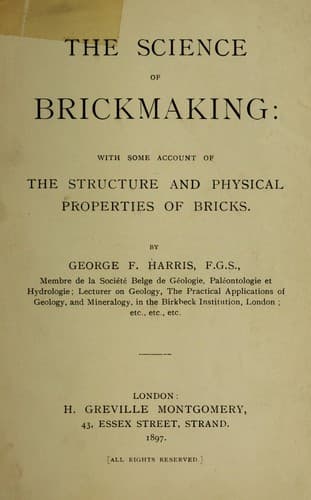
The Science of BrickmakingHarris, George Frederick
Science
The Science of Brickmaking
Harris, George Frederick
Brickmaking -- Handbooks, manuals, etc.
Even under the most favourable conditions, however--when the particles
composing the mass require a ¼-inch objective for their elucidation--we
find that the best burnt brick is largely made up of them in an
unmelted condition. And we should be very sorry to get rid of them; for
if they disappeared, the stony attributes of the brick would disappear
also, and the general value of the substance would be deteriorated to
such an extent that it would be unsaleable as a building material.
The brick would nearest resemble a form of slag. All we now insist
upon is that in brickmaking a chemical analysis is only useful up to
a certain point, beyond which we must appeal to the microscope to aid
us, and this in conjunction with as perfect a knowledge as possible as
to the behaviour of earths of certain mineral composition when under
the influence of high temperatures. In many instances, the value of the
brick depends almost entirely on incapacity for fusion on the part of a
large proportion of the minerals of which the brick is made. Possibly,
a good all-round brick would be where the bulk of its mineral particles
were infusible at the temperature employed, and when the remainder
were fusible enough to partially run, so as to cement or agglutinate
the infusible particles firmly together. In order to bring about such
conditions artificially, or to arrive at them even approximately, we
must know at least three things, viz.--(1) the nature of the mineral
particles involved in the whole operation; (2) their behaviour
under high temperatures; and (3) a knowledge of certain branches of
metallurgical chemistry. Now, obviously, we cannot undertake to teach
even the spirit of what is involved in these three _desiderata_ in a
small book like this; but we can, and shall, attempt to do something
in that direction, and we must ask the reader’s indulgence to take
for granted observations to be occasionally made, in the inevitable
prospect of our not being able to explain them at sufficient length.
The following are the principal minerals found in clays used in
brickmaking, together with their more important attributes from our
point of view.
KAOLIN.
Public-domain text, read in full here on John Shaqi.
Reviews
Reviews
No reviews yet
Be the first to share your thoughts on this work.
Join the Discussion
Join the discussion
Sign in to leave a comment or review.
Sign InorCreate an account