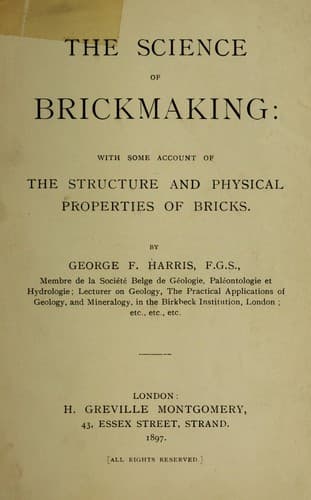
The Science of BrickmakingHarris, George Frederick
Science
The Science of Brickmaking
Harris, George Frederick
Brickmaking -- Handbooks, manuals, etc.
When it has plenty of room wherein to crystallise, and is not hemmed
in, as it were, by other hard crystalline matter, quartz often forms
beautiful six-sided prisms surmounted by a six-sided pyramid, and,
rarely, pyramids are found at both ends of a prism. There are no
lines, or “planes of cleavage,” to interfere with the transparency,
either in the extremely minute forms of the mineral as investigated
by the microscope, or in the gigantic crystals occasionally found.
Regular crystals of quartz, although by no means rare in Nature, are
seldom met with entire in brick-earths. The most common form of the
mineral is in irregular aggregates with other minerals, as in the rock
granite, which is composed essentially, as previously mentioned, of
quartz, felspar, and mica. We have traced the history of the felspar
on the decomposition of that rock, and it may now be said that on
complete disintegration of the granite a great part of the quartz
present is simply resolved into fragments and dealt with by rain and
other transporting agents. For quartz is practically imperishable; it
is almost proof against the deleterious acids in the atmosphere, which
so readily attack many other common minerals. In dealing with it, all
Nature can do (at least at the surface of the earth) is to carry the
small quartz grains and pieces about from place to place; She can,
and does, in this process, reduce the quartzose fragments by causing
them to continually knock against each other and against other mineral
fragments and masses until the grains and pieces find a resting place;
She may put them in a mill and grind them to powder, but the quartz is
still there.
Public-domain text, read in full here on John Shaqi.
Reviews
Reviews
No reviews yet
Be the first to share your thoughts on this work.
Join the Discussion
Join the discussion
Sign in to leave a comment or review.
Sign InorCreate an account