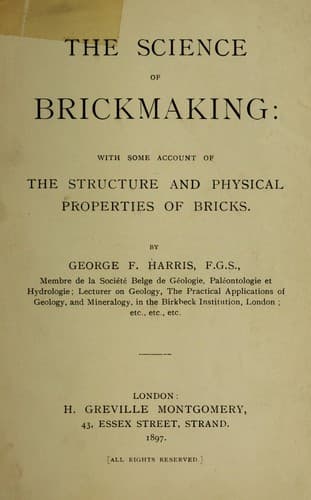
The Science of BrickmakingHarris, George Frederick
Science
The Science of Brickmaking
Harris, George Frederick
Brickmaking -- Handbooks, manuals, etc.
Another manner in which quartz occurs in Nature is as filling cracks
in rocks, but this is comparatively unimportant for our present
purposes. The purest quartz is known as rock crystal; but by far the
commonest kinds of the mineral are impure; they may contain iron,
schorl (a black needle-like crystal), and many other minerals. One of
the most interesting points about it, and which undoubtedly in certain
cases is of importance to the brick manufacturer as modifying its
melting properties, is the presence of myriads of extremely minute
so-called cavities, generally filled (or nearly filled) by liquids
of different kinds, the precise nature of which is not as well-known
as it might be, though in some instances it has been determined with
tolerable certainty. In some cases these inclusions are so numerous as
to obliterate the transparency of the quartz crystal, causing it to
present a frosted appearance. The fluids in these cavities may have
beautiful little crystals of other minerals, such as salt, floating
about--but it must be remembered that we are referring to something
infinitely little. These slight differences in the constitution of
minerals, however, have their influence in the kiln. For instance,
although the fluid present is usually water, that often contains carbon
dioxide, which acts as a species of flux to the quartz when present in
sufficient quantity.
In reference to the second form of silica present in brick-earths,
flint, that is of precisely the same chemical composition as quartz,
only that it is not crystalline, nor transparent, though thin pieces
of flint are translucent. Flint is by no means as common in Nature
as quartz; it is very hard, but brittle, and breaks with what is
termed a conchoidal fracture, from the fact that the fractured surface
frequently resembles the external appearance of the shell of a bivalve
mollusc. It occurs in a variety of ways; (1) often as hard lumps or
nodules running along in fairly regular layers in limestone rocks such
as chalk, and (2) occasionally filling up cracks or joints in such
rocks. It is hard to describe its origin in a few words, and we shall
not attempt it; all that need be noted is that it is frequently full of
the remains of extinct organisms of small size, which may, or may not,
constitute an impurity depending on the particular organism and its
present condition. When flint contains a fair proportion of iron it is
called chert--an extremely common constituent of brick-earths in some
localities--though that term refers to other rocks, such for instance,
as those made up almost exclusively of the siliceous spicules (hard
parts made of silica) of fossil sponges.
A more or less crystalline kind of silica is found, forming the
skeletons of minute aquatic plants, and these accumulating to some
depth, constitute the basis of such materials as Kieselguhr and the
diatom earth of the Isle of Skye, both of which, especially the former,
are used for making firebricks.
Public-domain text, read in full here on John Shaqi.
Reviews
Reviews
No reviews yet
Be the first to share your thoughts on this work.
Join the Discussion
Join the discussion
Sign in to leave a comment or review.
Sign InorCreate an account