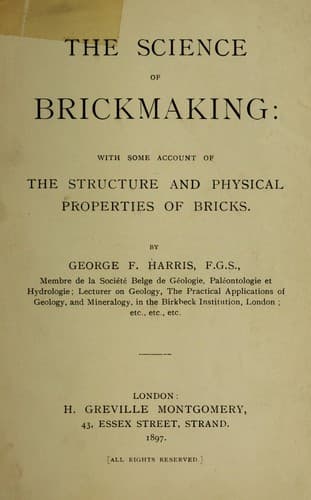
The Science of BrickmakingHarris, George Frederick
Science
The Science of Brickmaking
Harris, George Frederick
Brickmaking -- Handbooks, manuals, etc.
There is very little to be said concerning the behaviour of free
silica--quartz and flint--in the kiln. It is infusible except at
higher temperatures than are employed by the brickmaker. But, as we
have already remarked, the impurities often present in the minerals
form a species of flux which naturally brings them into the range
of fusible substances, though even then the temperature required is
far beyond what is usually attained in the majority of brickyards,
though it might be frequently arrived at in the manufacture of certain
fire-bricks. For all ordinary purposes, therefore, quartz and flint may
be regarded as infusible. In presence of much lime, iron, or similar
substances, however, both of them are readily melted, and it is part of
the science of brickmaking to know exactly how much lime, &c., to add
to yield the best results. Many brick-earths contain large quantities
of the calcareous and ferruginous substances alluded to, and are then
capable of being made into bricks direct, without any addition. But
although such natural brickmaking earths are frequently employed by the
manufacturer, nearly all of them could be made to yield a better brick
by a little artificial mixing. We must keep urging this point; there is
room for great improvement all round.
As with the majority of comparatively refractory substances, the
size of the grains and pieces of quartz and flint makes a difference
in their readiness to become fusible. The larger the grain the more
difficult it is to break down; fusion commences at the outside of a
quartz grain, the centre of which may at the same time be comparatively
unaffected. By arresting the fusing process, the microscope shows the
outside of the grain to have become softened (so much so as to affect
its doubly refracting properties), whilst the innermost parts still
retain their usual optical characters.
MICA.
The different varieties of mica are important as rock-forming minerals,
but they are not as often met with in brick-earths as is generally
supposed, except in insignificant quantity. Some of the purest clays,
however, contain a great deal of mica, derived almost directly from the
destruction of granite. The two commonest varieties of the mineral are
_biotite_ and _muscovite_.
BIOTITE MICA.--This mineral, usually known as ferro-magnesian mica,
is composed of silicates of magnesia, alumina, iron, and alkalies
in variable proportions. It occurs as six-sided plates or irregular
scales, usually of a bronze-black colour. Biotite weathers with
comparative facility, hence the reason why it is not more commonly met
with in brown and other impure clays.
Public-domain text, read in full here on John Shaqi.
Reviews
Reviews
No reviews yet
Be the first to share your thoughts on this work.
Join the Discussion
Join the discussion
Sign in to leave a comment or review.
Sign InorCreate an account