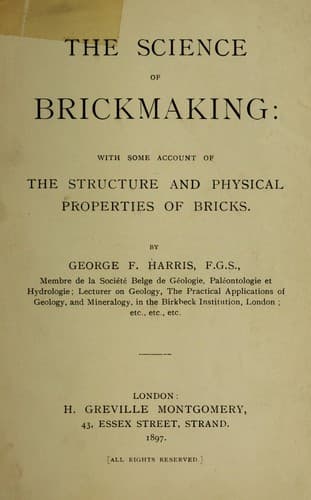
The Science of BrickmakingHarris, George Frederick
Science
The Science of Brickmaking
Harris, George Frederick
Brickmaking -- Handbooks, manuals, etc.
MUSCOVITE MICA.--This is sometimes called potash- or alumino-alkaline
mica, composed of the silicates of alumina, alkalies, iron, and
magnesia; the proportion of silica ranges from 45 to 50 per cent. It
may usually be distinguished at sight from biotite by its silvery white
or light brown colour. When large enough, both the micas mentioned
may be split up into thin plates, muscovite yielding large transparent
sheets. Compared with all other constituents of brick-earth, the micas
are bright and of semi-metallic lustre. Muscovite is more durable
than biotite, and is much more frequently met with in brick-earths,
especially in the sandy varieties.
The influence of mica in the kiln is not of much importance in ordinary
brickmaking; in general its alkaline character renders it fusible,
though a high temperature is necessary at all times to effect that.
In china-clay mica is regarded as a nuisance, and in breaking down
the material it is separated in the washing process by running water,
the mineral collecting in depressions or basins, called “micas.” When
muscovite contains much fluorine, as it frequently does, it is very
undesirable in clays for high-class purposes. At the best of times the
proportion of iron in mica is sufficient to mar the quality of the
otherwise most excellent clays. In the kiln, or porcelain furnace, the
presence of mica (more particularly biotite) is apt to create yellow
and brown specks, or a species of mottling. It is highly satisfactory,
therefore, to note that these little shiny flakes may be easily floated
off by a moderate amount of care in washing, and thus separated from
the other constituents of the clay.
IRON.
Except in regard to white kaolin clays, nearly all earths used in
brickmaking contain more or less iron, which is usually present as
protoxide in many mineral constituents. The colouring matter of clays
is generally iron in some form, and blue clays weather into brown by
the alteration of that mineral. It is unnecessary for us to consider
the various minerals of the iron group; all we need do is to state the
mode of occurrence of iron oxides in clays and earths, to consider a
variety known as iron-pyrite, and the general effects of ferruginous
minerals in the kiln.
Public-domain text, read in full here on John Shaqi.
Reviews
Reviews
No reviews yet
Be the first to share your thoughts on this work.
Join the Discussion
Join the discussion
Sign in to leave a comment or review.
Sign InorCreate an account