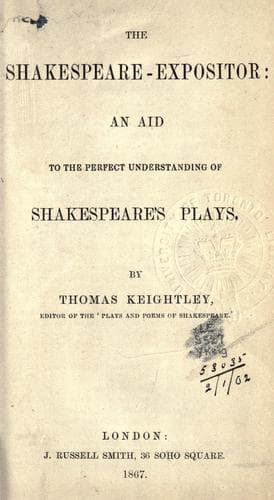
The Shakespeare-Expositor: An Aid to the Perfect Understanding of Shakespeare's PlaysKeightley, Thomas
General
The Shakespeare-Expositor: An Aid to the Perfect Understanding of Shakespeare's Plays
Keightley, Thomas
Drama -- Outlines, syllabi, etc.; Shakespeare, William, 1564-1616 -- Outlines, syllabi, etc.
The relations between Shakespeare and his family during this time
are in a state of ambiguity, which no conjecture can fully clear up.
There is not the slightest ground for supposing that he ever was
on ill terms with his wife; and surely we have no right to suppose
that, like La Fontaine, he left her in the country while he himself
lived in the metropolis; for Shakespeare was a householder, while La
Fontaine lived usually in the _hôtels_ of his patrons. The more natural
supposition is that he would have removed his wife and children to
London as soon as he had got a firm footing there. Certainly no entry
of the birth of any child of his is to be found in the register of any
London parish; but may not some physical change, with which we are
unacquainted, have caused his wife to cease from childbearing after
the birth of the twins? There is also no entry of this kind in the
register of Stratford; and yet it can hardly be that he, any more than
La Fontaine, abstained from the bed of his wife in the annual visits
which, according to Aubrey's very probable account, he was in the habit
of making to his native town. But the burial of his son Hamnet took
place in Stratford on the 11th of August, 1596, whence it might appear
that the family was living there at that time. To this, however, it
may be replied that the family, though usually resident in London, may
have been down at Stratford when Hamnet took ill, or that he may have
taken ill in London and have been ordered by the physicians to try
the effect of his native air, or that, finally, he may have died in
London, and his body have been taken down to Stratford for interment
with his family, an act quite in character with Shakespeare. The mist,
therefore, remains so far undispelled. But we are also to remember
that Shakespeare, as above stated, was a householder in London, which
might seem to intimate that he had a family there. It is to me a matter
of extreme difficulty to believe that he who created so many of the
loveliest female characters that the world has ever witnessed, should
have led, as, we may say, he otherwise must have done, an irregular
life with regard to the sex; for the effect of such conduct is almost
always a degrading view of female nature; and how pure on this
subject his ideas must always have been is strongly indicated by the
circumstance that three of his most lovely female characters--Perdita,
Miranda, Imogen--occur in the very last plays he wrote. We may here
note the difference between him and La Fontaine. On the whole, then,
my opinion is that Shakespeare had his wife and children with him in
London, and that his life there was as regular and domestic as his
profession permitted.
Public-domain text, read in full here on John Shaqi.
Reviews
Reviews
No reviews yet
Be the first to share your thoughts on this work.
Join the Discussion
Join the discussion
Sign in to leave a comment or review.
Sign InorCreate an account