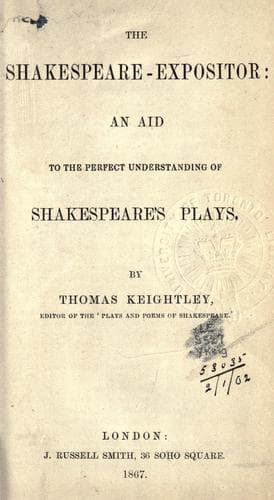
The Shakespeare-Expositor: An Aid to the Perfect Understanding of Shakespeare's PlaysKeightley, Thomas
General
The Shakespeare-Expositor: An Aid to the Perfect Understanding of Shakespeare's Plays
Keightley, Thomas
Drama -- Outlines, syllabi, etc.; Shakespeare, William, 1564-1616 -- Outlines, syllabi, etc.
It has been argued, from a passage in Twelfth Night, in which a man is
advised always to marry a woman younger than himself, that Shakespeare
had felt the evil consequences of the opposite course. But surely we
should not press thus closely language resulting from the situation of
a character in a drama. And if Shakespeare was so convinced of the ill
consequences of such a procedure, how came it that only a few months
before his death he gave an apparently cheerful consent to the marriage
of his daughter Judith with Thomas Quiney, who was four years her
junior? This objection, then, also may be dismissed, and we remain as
uncertain as ever.
We may also venture to deal in a similar way with a passage in the
Tempest (iv. 1.), condemnatory of the conduct which he and his wife
had pursued before their marriage. Further, as the only mention
of his wife in his will is an interlineation, bequeathing her his
"second best bed, with the furniture," a want of due regard for her
comfort and independence has been inferred. But this in reality is
rather indicative of affection; for, as Mr. Knight was the first to
observe, as his property was mostly freehold, the law provided for her
by assigning her what it terms dower. Lastly, the desire which Mrs.
Shakespeare is said to have expressed to be buried with her husband is
surely some proof of mutual affection.
It would also seem to be a matter of which there can be little doubt,
that Shakespeare must have been an indefatigable reader during the
first years of his residence in London. It is strange how none of the
commentators appear to have been aware of this fact; for it is the only
way of accounting for the remarkable copiousness of his vocabulary.
Max Müller, following Professor Marsh, in his Lectures on the Science
of Language, having observed, on the authority of a country clergyman,
that some of our peasantry have not more than 300 words in their
vocabulary, proceeds as follows:--
"A well-educated person in England, who has been at a public school and
at the university, who reads his Bible, his Shakespeare, the Times,
and all the books of Mudie's Library, seldom uses more than about 3000
or 4000 words in actual conversation. Accurate thinkers and close
reasoners, who avoid vague and general expressions, and wait till they
find the word that exactly fits their meaning, employ a larger stock;
and eloquent speakers may rise to a command of 10,000. Shakespeare, who
displayed a greater variety of expression than probably any writer in
any language, produced all his plays with about 15,000 words; Milton's
works are built up with about 8000; and the Old Testament says all that
it has to say with 5642 words."
Public-domain text, read in full here on John Shaqi.
Reviews
Reviews
No reviews yet
Be the first to share your thoughts on this work.
Join the Discussion
Join the discussion
Sign in to leave a comment or review.
Sign InorCreate an account