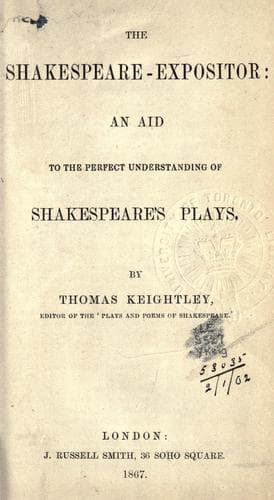
The Shakespeare-Expositor: An Aid to the Perfect Understanding of Shakespeare's PlaysKeightley, Thomas
General
The Shakespeare-Expositor: An Aid to the Perfect Understanding of Shakespeare's Plays
Keightley, Thomas
Drama -- Outlines, syllabi, etc.; Shakespeare, William, 1564-1616 -- Outlines, syllabi, etc.
Now how else but by reading could Shakespeare have got such a store of
words? It could not be by conversation, and he surely did not invent
more than a few of them. This also tends to prove that Venus and Adonis
was not written at Stratford; for his rural vocabulary could hardly
have sufficed for such a poem.
But further, I think I am justified in asserting that during the
earlier years of his dramatic career Shakespeare acquired a competent
knowledge of the French and Italian languages. As we shall see, some
of his plays were founded on Italian tales and plays of which no
translation has ever been discovered; and the natural inference then
is, that he had read them in the original. As to the French, he must
have been able to write as well as read it. As a proof, in his Henry V.
there are scenes of mingled French and English, which scenes are, like
all the prose scenes in our old dramatists, in what I have denominated
_metric prose_; and this could only be caused by the whole scene having
been the production of the one mind. The French, too, is incorrect,
as it is also in the really prose French scene between Katherine
and Alice. It seems therefore probable in the highest degree that
Shakespeare was able to write French. In like manner Ben Jonson has
shown in his Alchemist and elsewhere, that he was able to write Spanish
and other languages.
Another curious question is, Was Shakespeare ever out of England? This,
too, cannot be determined; but it is clear to me, from various passages
of his plays, that he must have been familiar with the sea-shore; and,
from his correct use of nautical terms, we might suspect that he had
been at sea on board a ship once, if not oftener. I cannot see any
equal proof of his having been familiar with mountain scenery; and
from the comparative vagueness of his language respecting mountains in
Cymbeline and elsewhere, I rather suspect that he had never gazed on a
mountain-range.
In 1597, the year after he had lost his only son, Shakespeare began to
carry into effect his long-cherished project of acquiring property in
his native county. For the seemingly trifling sum of £60 he purchased
from William Underhill one of the best houses in the town of Stratford,
named New Place, built by Sir Hugh Clopton in the reign of Henry VII.,
consisting of one messuage, two barns, and two gardens, with their
appurtenances. It was situated in Chapel-street Ward; and as, in a
note taken of corn and malt during a dearth in the beginning of the
following year, we find him set down as the holder of ten quarters,
it would appear that his family, if not he himself, must have been
residing at that time in this place.
Public-domain text, read in full here on John Shaqi.
Reviews
Reviews
No reviews yet
Be the first to share your thoughts on this work.
Join the Discussion
Join the discussion
Sign in to leave a comment or review.
Sign InorCreate an account