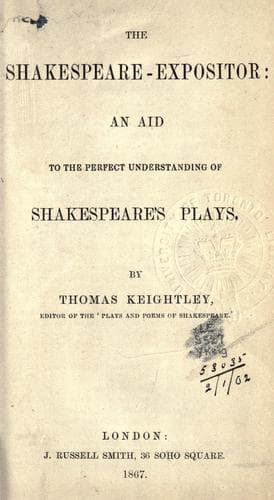
The Shakespeare-Expositor: An Aid to the Perfect Understanding of Shakespeare's PlaysKeightley, Thomas
General
The Shakespeare-Expositor: An Aid to the Perfect Understanding of Shakespeare's Plays
Keightley, Thomas
Drama -- Outlines, syllabi, etc.; Shakespeare, William, 1564-1616 -- Outlines, syllabi, etc.
For some years subsequent to this date we find a few notices of
purchases &c. in which Shakespeare was engaged, but nothing that throws
any light on his personal history. Neither can we ascertain at what
time it was that he disposed of his theatric property; for that he
did so is plain, as he says nothing of it in his will. It would seem,
however, to have been subsequent to 1610. It would also appear that
he lived in Stratford in very handsome style, probably exercising a
generous hospitality; for we learn from the diary of the Rev. J. Ward,
vicar of that town in 1662, that he had _heard_ that Shakespeare "spent
at the rate of £1000 a-year." This sum, however, though not by any
means so large, relative to the present value of money, as is usually
supposed, is utterly incredible; but still it proves the tradition of
his housekeeping having been liberal.
On the 5th of June, 1607, Shakespeare's eldest daughter, Susanna, was
married to Dr. John Hall, a physician of some eminence, settled in
Stratford. They had but one child, a daughter named Elizabeth, who was
married first to Thomas Nash, and secondly to John (afterwards Sir
John) Barnard, of Abington, in Northamptonshire. She died in 1649,
having had no children by either husband; and with her ended the lineal
descent from the great Shakespeare; for Judith, his other daughter,
who married a couple of months before his death, though she had three
sons, outlived them all, as none of them attained to the age of twenty
years. Poetic genius seems fated never to found a family; it is above
the vulgar distinctions of human life.
We know not the exact date of Shakespeare's final departure from London
and settlement at Stratford; but it probably was not much later than
the year 1610. His life after his retirement was not destined to be
very long. We may picture him to ourselves as passing his days in
tranquil enjoyment, interesting himself somewhat in the affairs of the
borough, conversing with his neighbours, telling anecdotes of his life
in London, reading his Bible and Chaucer, Spenser, and other poets,
and no doubt his North's Plutarch, giving occasional play to his wit,
in short, leading the life of a wise and sensible man, contented with
the condition he had made his mature choice of as most productive of
happiness.
Public-domain text, read in full here on John Shaqi.
Reviews
Reviews
No reviews yet
Be the first to share your thoughts on this work.
Join the Discussion
Join the discussion
Sign in to leave a comment or review.
Sign InorCreate an account