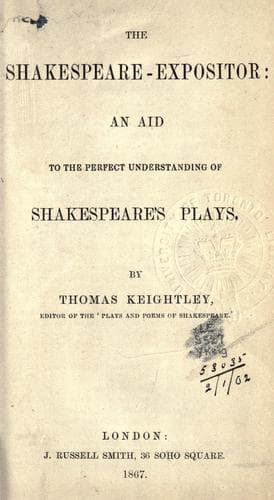
The Shakespeare-Expositor: An Aid to the Perfect Understanding of Shakespeare's Plays — John Shaqi
The Shakespeare-Expositor: An Aid to the Perfect Understanding of Shakespeare's PlaysKeightley, Thomas
General
The Shakespeare-Expositor: An Aid to the Perfect Understanding of Shakespeare's Plays
Keightley, Thomas
Drama -- Outlines, syllabi, etc.; Shakespeare, William, 1564-1616 -- Outlines, syllabi, etc.
It is probable that in his fifty-second year he felt a decline in his
constitution which reminded him of the uncertainty of life; for on
the 25th of January, 1615-16, he made his Will, which was executed
exactly two months later; and on the 23rd of the following April he
breathed his last. He was buried in the church of Stratford, where his
grave and monument may still be seen. The disease of which he died is
unknown. The vicar, Mr. Ward, already referred to, says, "Shakespeare,
Drayton, and Ben Jonson had a merry meeting, and, it seems, drank too
hard; for Shakespeare died of a fever there contracted." This no doubt
is not impossible, but it is not very probable. If we may judge from
passages in his plays, Shakespeare was an enemy to deep drinking; and
it is hardly likely that he should, so late in life too, have committed
such excess (worthy only of a Burns) as is here supposed, even in the
company of Ben Jonson, a visit from whom to Stratford, if he had made
it, would with its consequences in all probability have formed part of
his communications to Drummond two years later. We may then, I think,
safely venture to reject this account of Shakespeare's death, and
acknowledge that its cause is utterly unknown, and will probably always
remain unknown.
It would appear from Shakespeare's Will that he had at the time of his
death but very little money; for, excepting a few trifling legacies,
the only sum mentioned is £300 which he left to his younger daughter
Judith, making apparently a very unequal division of his property; for
to his elder daughter Susanna he left all his lands, tenements, etc.,
in Stratford and elsewhere, the value of which must have been very far
beyond that of the sum devised to Judith. In fact we might suppose that
the property enumerated in a general way in his Will had cost more, and
were of greater value than would seem to be indicated.
Public-domain text, read in full here on John Shaqi.
Reviews
Reviews
No reviews yet
Be the first to share your thoughts on this work.
Join the Discussion
Join the discussion
Sign in to leave a comment or review.
Sign InorCreate an account