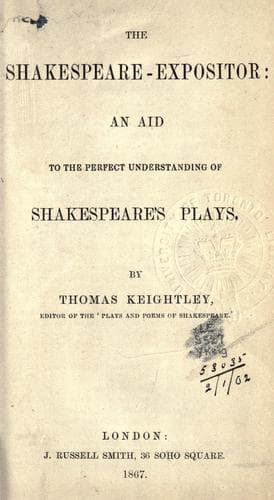
The Shakespeare-Expositor: An Aid to the Perfect Understanding of Shakespeare's Plays — John Shaqi
The Shakespeare-Expositor: An Aid to the Perfect Understanding of Shakespeare's PlaysKeightley, Thomas
General
The Shakespeare-Expositor: An Aid to the Perfect Understanding of Shakespeare's Plays
Keightley, Thomas
Drama -- Outlines, syllabi, etc.; Shakespeare, William, 1564-1616 -- Outlines, syllabi, etc.
It might be supposed that the cause of this unequal division was
displeasure at Judith's marriage; but, beside that we have no proof of
any such feeling towards her, the real cause lies evidently far deeper.
It was his passionate desire to be the founder of a family in his
native county. This it was that animated all his theatric exertions,
and he regarded the wonderful creations of his genius merely as means
to this one great end. We might have presumed that the death of his
only son in 1596 would have given a check to this passion; but, on
the contrary, it was, as we have seen, in the very next year that he
commenced purchasing property in Warwickshire; and we also find that
in that year, or more certainly in 1599, a grant of arms was made to
John Shakespeare by the Heralds' College, in which he was authorized
to impale the bearings of the Ardens, his wife's family, with his own;
and the probability would seem to be, that previously the Shakespeare
family had had no coat of arms. By a statute, however, of the later
Plantagenets every freeholder was to have his proper _seal_ of arms;
and that of the Shakespeares may have been the eagle and spear, whence
the Heralds easily formed the coat of arms used by Shakespeare. In
obtaining this, John Shakespeare must have acted under the influence
and at the expense of his son William.
In his Will, Shakespeare leaves his lands, tenements, &c. to his
daughter Susanna, and after her death to her eldest son and his heirs
male, and, in default of heirs male of him, to her second son, and so
on to the seventh son, and, in default of such issue, to his _niece_
(_i.e._ granddaughter) Elizabeth Hall and her heirs male, and, in
default of them, to his daughter Judith and her heirs male, and, in
their default, to the right heirs of the testator.
Every precaution we see was here taken, but all in vain; for, as we
have hinted, it seems to be the order of Providence that literary
genius should not be the foundation of worldly rank and greatness. Most
persons will here call to mind the parallel case of Sir Walter Scott,
who, too, as fondly and as vainly yearned to be the founder of a part
of the rural aristocracy of his native land, and in whose eyes it was
greater to be Laird of Abbotsford than the author of Waverley. But
the advantage was on the side of the bard of Avon; for _he_ sought no
literary fame, content with a life of peace and competence, while the
Scottish baronet would fain have had literary fame as well as wealth
and title. How different were the latter days of the two men!
* * * * *
Public-domain text, read in full here on John Shaqi.
Reviews
Reviews
No reviews yet
Be the first to share your thoughts on this work.
Join the Discussion
Join the discussion
Sign in to leave a comment or review.
Sign InorCreate an account