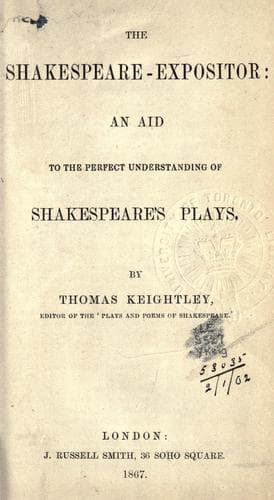
The Shakespeare-Expositor: An Aid to the Perfect Understanding of Shakespeare's Plays — John Shaqi
The Shakespeare-Expositor: An Aid to the Perfect Understanding of Shakespeare's PlaysKeightley, Thomas
General
The Shakespeare-Expositor: An Aid to the Perfect Understanding of Shakespeare's Plays
Keightley, Thomas
Drama -- Outlines, syllabi, etc.; Shakespeare, William, 1564-1616 -- Outlines, syllabi, etc.
That Shakespeare possessed that _aroma_ of humour which we denominate
_wit_, beyond any of his contemporaries or successors, is a matter
about which, I think, there cannot be two opinions. I will not deny
that in nervousness Jonson may have equalled him, but I certainly know
not where to look for the sublime in Beaumont which rivalled that
of Macbeth and Lear; and unquestionably I should never even dream
of putting the morbid softness of Fletcher in comparison with the
genuine manly pathos of Shakespeare. There was however one thing in
which I must confess they all exceeded him--perspicuity; for though
in many, very many parts of his plays the language is most lucid
and unconstrained, there are others--in Troilus and Cressida for
instance--which task the intellect to understand them, and which never
could have been intelligible to an ordinary audience. But the fact
is, neither he nor any other of his brother dramatists ever seems to
have asked himself the simple question, Will the audience understand
this? I finally must assert, in opposition to Gifford, that, where
Shakespeare's verse is uninjured, we have abundant proof that no poet
ever excelled him in "rhythmical modulation," and that, when we would
produce the most melodious verse in our language, it is in his plays
that we shall find our best specimens. It seems to me quite idle to
say with Coleridge that Shakespeare's verse is peculiar in rhythm and
structure; for, from the nature of verse, it could not be so. It is
just as idle to say with Johnson that the blank verse of Thomson is
not that of Milton. The difference in such cases lies wholly in the
language; and that of Shakespeare _is_ peculiar. This is caused by
an excess of figurative expression, in which his metaphors are often
broken and confused and his similes imperfect, by inversions and
transpositions, and by the use of words in unusual and even incorrect
senses.
Shakespeare's power of observation must have been not merely extensive
but marvellous:--
"He walk'd in every path of human life,
Felt every passion, and to all mankind
Doth now, will ever, that experience yield
Which his own genius only could acquire."
Public-domain text, read in full here on John Shaqi.
Reviews
Reviews
No reviews yet
Be the first to share your thoughts on this work.
Join the Discussion
Join the discussion
Sign in to leave a comment or review.
Sign InorCreate an account