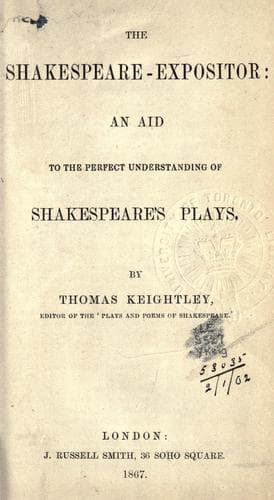
The Shakespeare-Expositor: An Aid to the Perfect Understanding of Shakespeare's Plays — John Shaqi
The Shakespeare-Expositor: An Aid to the Perfect Understanding of Shakespeare's PlaysKeightley, Thomas
General
The Shakespeare-Expositor: An Aid to the Perfect Understanding of Shakespeare's Plays
Keightley, Thomas
Drama -- Outlines, syllabi, etc.; Shakespeare, William, 1564-1616 -- Outlines, syllabi, etc.
Nothing, in fact, high or low, seems to have escaped him; he discerned
the nicest shades and varieties of looks, of manners, of language.
He had also, in a remarkable degree, that power--that clairvoyance,
as we may perhaps venture to term it--so requisite to the dramatist
and the novelist, of developing from the faintest sketch, the merest
outline, the entire of a character, with its appropriate sentiments,
action, and language. In the number and variety of characters no writer
ever equalled him, and all are fully and completely delineated, none
are, as in other dramatists, mere sketches. Some, such as his Clowns,
are peculiar to himself; we meet with no Clowns in the dramas of his
contemporaries and successors,--the Gracioso of the Spanish drama,
an independent creation, being the nearest approach to them. But of
all his creations what has always most astonished me are his women.
They are exclusively his own; Fletcher, Massinger, or any other, has
nothing like them. Perhaps the nearest approach is made in Spain also,
by Cervantes; in whom, however, as in the Spanish drama, they want
variety. They would seem to have been produced, if I may so express it,
by a projection of his own gentle and noble nature into female forms;
for he surely never met his Rosalinds, Mirandas, and Perditas in real
life, though he _may_ have had some faint sketches of some of them in
his own daughters. He seems to have shrunk almost instinctively from
portraying bad women. Goneril and Regan alone are unredeemed; for Lady
Macbeth is awful, not detestable, and even the Queen of Cymbeline is
but an Agrippina, for like her she is criminal but not selfish.
In fine, though I will not, with Mr. Buckle, term Shakespeare "the
greatest of the sons of men"--for I cannot give that preeminence to
imagination, observation, and language over the other mental powers,
so as to place him above Aristotle and Newton--I will say here of
him, as I have said in my 'Life of Milton' that "he was the mightiest
poetic mind that Nature has ever produced," and that, in his case,
statues and other memorials are utterly needless and superfluous. If
we are asked for his monument, we should simply point to his Plays and
say,--_Monumentum si quæris, inspice!_ and, in my opinion, he consults
best for the poet's fame who seeks to restore his works to their
pristine form.
The reader will see by this sketch how little is really known
concerning Shakespeare. I have endeavoured, as will be seen, to rectify
some points in his biography.
EDITIONS, DATES, AND ORIGINS OF SHAKESPEARE'S PLAYS.
IN 1598 appeared a work, named Palladis Tamia, written by Francis
Meres, in which among other passages respecting Shakespeare we meet
with the following:--
Public-domain text, read in full here on John Shaqi.
Reviews
Reviews
No reviews yet
Be the first to share your thoughts on this work.
Join the Discussion
Join the discussion
Sign in to leave a comment or review.
Sign InorCreate an account